Showing posts with label Bret Easton Ellis. Show all posts

Thursday, December 15, 2011

Breathing House of Leaves Tattoos

Everybody knows how much I love Six Feet Under and, after five incredible seasons, its finale and last sequence with Claire driving cross-country and time passing on relentlessly. And I love the song that plays over it and have listened to it so many times but I just came around to see the actual music video of it for the first time: Sia - Breathe Me

Why does it remind me of House of Leaves so much? Along with the video, I think, the song reverberates much much more with the book than Poe's Haunted or Angry Johnny.

Talking about House of Leaves, I came across this book cover art by Bas Alberts, which made 3rd place in the 50 Watts' polish book cover contest:

Since I liked it so much, I altered it and put it on a shirt. It's under a creative commons license and I only have to give the designer's name, which I did above and will tell everybody who asks me about the shirt.


Note: The blue leaves are actually navy-blue and the square next to the word House is exactly 5/16 of an inch big + the whole thing and therefore the words are mirrored. Then I made something up for the back, too.


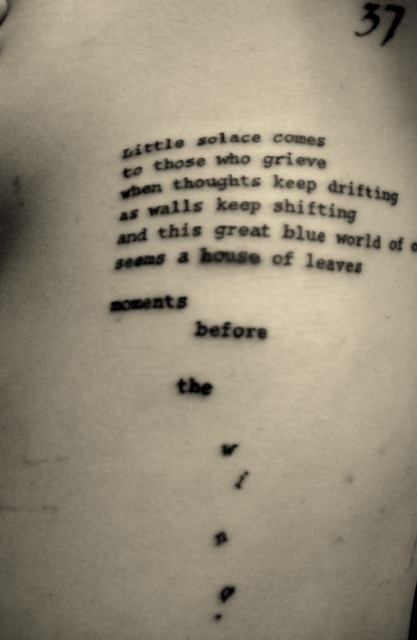
I still need some suggestions for a House of Leaves inspired tattoo. Shouldn't be as big as these:


Or maybe something Bret Easton Ellis?


or David Foster Wallace?

Why couldn't I find a pic of a thumper tattoo barely an inch from a shaved pussy? This is the internet! Has nobody got such a tattoo? I can hardly believe that.

Monday, October 17, 2011

American Inferno - Bret Easton Ellis and Centralia

I found a Paris Review article about Centralia, that little town in Pennsylvania that is now burning underground for more than fifty years. And I wanted to write about it a couple days ago. Why would I want to do that? Because the movie version of Silent Hill used Centralia as its model for the town and shifted the whole background story of the videogame on this town of burning coal-mines and disrupted streets. And I liked that The Paris Review would do an article about it. But then I forgot or didn't have the time or just didn't bother too much.

But just about a couple minutes ago I received news (that are already four days old) that are intricately linked with the Centralia thing that I now have to talk about it. Well, Roger Avary, probably best known for co-writing the script for Pulp Fiction with Tarantino, also wrote the script for the first Silent Hill movie. And he also wrote the screenplay for Bret Easton Ellis's Rules of Attraction as well as directed the flick, which is the one really really good film adaptation of a Bret Easton Ellis novel that exists, and BEE loves Avary for that (as well as I do; well, on a whole different level, maybe). Just watch this little piece that introduces Victor Ward/Johnson into The Rules Of Attraction. Victor became later the protagonist of Ellis's masterpiece, Glamorama. Or this one, THE most amazing suicide scene ever.

Well, a lot of talk has been around if Avary would ever be able to raise the money for finally filming Glamorama, and it never looked very promising, because of 9/11 and are the Americans really ready for a movie like this and isn't it kind of too late now, anyway? But consider this tweet from Ellis, dated 10/13/11:
Just finished reading Roger Avary's adaptation of "Glamorama" which he will direct next year. Hilarious, horrific, sad. He's a mad genius.
So, this now makes top of my most eagerly awaited films list. In the meantime: Watch/Rewatch The Rules of Attraction. Avary really did the best job of his career with this one and if he had a hand in the casting as well, everything Bret tweeted is true: Hilarious, horrific, sad. He's a mad genius.

Tuesday, June 14, 2011

emotion and irony in contemporary fiction

"What I'm mostly trying to talk about is what it feels like emotionally to be 34 in this country."
This is from a DFW interview from Spring 1997 that can be found here and it pretty much sums up what is going on and what has to be done in serious contemporary fiction, i.e. the turning-away from postmodern irony and the turning toward emotional truth. You can see it in DFWs work, most recently in The unfinished Pale King, you can see it in Alan Ball's Six Feet Under, it is what Bret Easton Ellis did in Lunar Park, what Dave Eggers's A Heartbreaking Work of Staggering Genius was all about, as well as Foer's Everything Is Illuminated and also recent TV-shows as Bored to Death - although sometimes they hide it very well -, it is what Terrence Malick does and what Jonathan Franzen's Freedom tries to do. Also Running With Scissors comes to mind, and quite strongly though, i.e. the movie version, I haven't read the memoir. And this is what an LA Times critic had to say about it :
"Murphy, who created the creepy, funny, lunatic "Nip/Tuck," is a master of mordant and macabre camp. But here he loses his teeth, seeming to lack any ironic distance from material that practically begs for it."
The critic herself doesn't seem to lack the ironic distance that she is actually begging for, though. I don't know where to find it right now, but Jonathan Franzen said it in one of the myriad of interviews he gave in the wake of Freedom. He said that in The Corrections he used irony also and especially to distance himself from certain ideas and emotions presented in the novel. You can basically say anything you want with irony and then easily back out of it if people disagree with you, thus you don't have to stand your ground on very intimate issues, issues that are and feel way too personal to let anyone attack or make fun of them. He said that he wrote a wholeheartedly unironic novel with Freedom, that he eschewed former techniques of irony to get closer to the emotional core of what he wanted to say. And that he is quite aware that exactly that makes him so much more vulnerable if people dislike his work because now the work is much closer to what being Jonathan Franzen really is like. Closer to the emotional truth that is Jonathan Franzen. But people might misread that for sentimentality and naiveté.

Here is something I found in an IRC chat transcript with DFW* shortly after the release of Infinite Jest (and if you are too young to actually have been in one yourself or are now like, my age, and want to get a nice pretty nostalgic trip into the early times of the internet and 90's chat-rooms, you have to read the whole thing (if it doesn't redirect you, click on the Impatient? link). This is pre-facebook stuff. There were actually online chat-rooms BEFORE the internet. Grab yourself a cup of coffee or your beverage-of-cozy-choice and travel into 1996's cyberspace):
"The worst thing about irony for me is that it attenuates emotion" and
"I don't think irony's meant to synergize with anything as heartfelt as sadness. I think the main function of contemporary irony is to protect the speaker from being interpreted as naive or sentimental."
Irony can be a lot of fun, no doubt. And as Dave puts it, we can't escape it because we breathe the stuff everyday. And that makes it actually hard to snap out of it sometimes. (Is the transition to this paragraph too rough? I had a hard time coming up with a coherent one after the quotes.) And I think that is exactly what happened to the LA Times critic a couple lines above. She sees the lack of ironic distance and wants her ironical borders restored immediately to not have to look too closely at something that intends to produce exactly this: a close emotional relationship with its audience. It is precisely not about irony, not about safe distance, not about making fun of everything. It is about emotion. And in the case of this critic, and a lot of others, I fear, about the misreading as being naive and sentimental.

*almost all DFW-related sources are found and taken from The Howling Fantods.

Tuesday, May 24, 2011

Cannes Update - The Tree of Life - Melancholia

Despite the bad critics and some booing from... blablabla. The Tree of Life went on to win Cannes' Palm d'Or. This is then Malick's second win at Cannes after 1979s Best Director award for Days of Heaven, which also won the Oscar for Best Cinematography, that is, the cinematographer did, Néstor Almendros. June 16, keep in mind.

After Lars Von Trier was declared persona non grata in Cannes for committing the crime of babbling about Hitler and Speer and the bunker and his joking about being a Nazi in this press conference, Kirsten Dunst nevertheless went on to win the award for Best Actress for von Trier's Melancholia, which will succeed The Tree of Life, after June 16, as the film I'm anticipating most. What Bret Easton Ellis has to say about the whole thing:
Kirsten Dunst looked a lot sadder when I ran out of coke at an Oscar party 5 years ago than at the Von Trier press conference at Cannes...

Thursday, April 28, 2011

The cre(m)ation of Dave Eggers and Bret Easton Ellis

The little m devours everything in flames. Both are highly energetic processes and thus Dave Eggers seems to be burning on both ends in his memoir A Heartbreaking Work of Staggering Genius. He uses the cremation of his parents to fuel his life and writing process, infused with their ashes. And what he does seems a pretty good waste of my time. I don't find this work heartbreaking at all but often emotionally true in it's plain and accurate descriptions of Eggers's cognitive processes. And there, what many seem to recognize as his genius, is the place where his meta-meta-reflections tell us about the feedback and repercussions between his heart and brain which are so good because everyone can easily relate to them. But it gets a bit tiresome after a while. The effect of his paranoid episodes - both with the worst and best outcomes -, while true and thus amusing and comforting, easily wears off after a couple of hundred pages and leaves little more than the stale aftertaste of show-offy writing techniques. But nevertheless this is a pretty good read.

Back to the ashes: Bret Easton Ellis did a similar thing with his own memoir, which is what I like to call Lunar Park. It is all about rising from the ashes of his father and creating his beautiful art out of the remains of this cremation. The next to last paragraph of Lunar Park is all about the ashes and how they form and seep into his life, his childhood memories, his anxieties, his desires, moods and, of course, his writing. The ashes going through the very pages of this book, creating new words and thus worlds and his life, which is, after all, a literary one.

I wonder if there's any other book or work of art that deals that explicitly with the process of its creation through the process of cremation of life. I mean literally. Because it's a nice and beautiful image that the ashes fall onto the white (or black) page and produce the letters which constitute its texture and meaning.