Showing posts with label literature. Show all posts

Thursday, February 14, 2013

Donna Tartt's The Goldfinch to be published in October


I know it's been a long time since I posted something. Took me more than a year to get back to this blog. In blogging terms compared to the real world that would be like, let me think... EXACTLY 11 years! Which is precisely the amount of time that will have passed by since Donna Tartt's second novel The Little Friend came out when finally her third, The Goldfinch, will be published on October 22. If you travelled along my pages here, you might have taken note that her third novel has always been on top of my eagerly awaited list of things to come. This is now how Amazon describes it:
A young boy in New York City, Theo Decker, miraculously survives an explosion that takes the life of his mother. Alone and determined to avoid being taken in by the city as an orphan, Theo scrambles between nights in friends’ apartments and on the city streets. He becomes entranced by the one thing that reminds him of his mother: a small, mysteriously captivating painting that soon draws Theo into the art underworld.
Composed with the skills of a master, The Goldfinch is a haunted odyssey through present-day America. It is a story of loss and obsession, survival and self-invention, and the enormous power of art.
The 2008 press release from Little, Brown described it as
a story of loss and obsession about a young man, guilt-stricken and damaged after the death of his mother, and the growing power that a stolen piece of art exercises over him, drawing him into an underworld of theft and corruption where nothing is as it seems .

Someone noted that the remaining 8 months will feel way longer than the past 10 years. To make it easier for all of us, why not reread The Secret History or The Little Friend or listen to Donna's brilliant voice on the audiobook versions of them. Those, especially The Secret History (The Little Friend comes only in a heavily abridged version with her reading it herself) and her reading of True Grit are the epitome of storytelling. She is, after all, a master storyteller in every respect.

I wrote something about one and a half years back on her. Just scroll down or click these links: Donna Tartt takes her time and Come then, and let us pass a leisure hour in storytelling...

Thursday, December 15, 2011

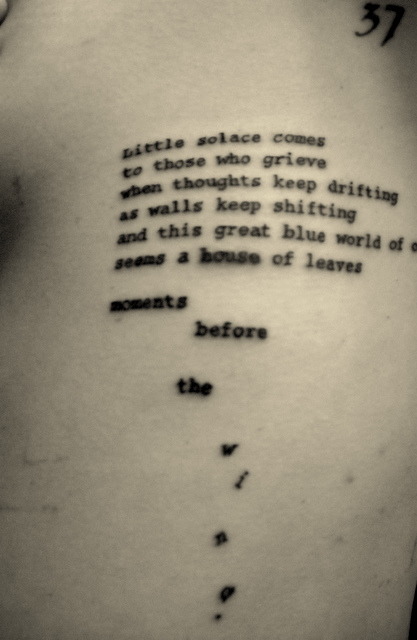
Breathing House of Leaves Tattoos

Everybody knows how much I love Six Feet Under and, after five incredible seasons, its finale and last sequence with Claire driving cross-country and time passing on relentlessly. And I love the song that plays over it and have listened to it so many times but I just came around to see the actual music video of it for the first time: Sia - Breathe Me

Why does it remind me of House of Leaves so much? Along with the video, I think, the song reverberates much much more with the book than Poe's Haunted or Angry Johnny.

Talking about House of Leaves, I came across this book cover art by Bas Alberts, which made 3rd place in the 50 Watts' polish book cover contest:

Since I liked it so much, I altered it and put it on a shirt. It's under a creative commons license and I only have to give the designer's name, which I did above and will tell everybody who asks me about the shirt.


Note: The blue leaves are actually navy-blue and the square next to the word House is exactly 5/16 of an inch big + the whole thing and therefore the words are mirrored. Then I made something up for the back, too.


I still need some suggestions for a House of Leaves inspired tattoo. Shouldn't be as big as these:


Or maybe something Bret Easton Ellis?


or David Foster Wallace?

Why couldn't I find a pic of a thumper tattoo barely an inch from a shaved pussy? This is the internet! Has nobody got such a tattoo? I can hardly believe that.

Saturday, December 03, 2011

an octopus?

Yes it is the biggest fucking octopus Slothrop has ever seen outside of the movies, Jackson.


Talkin bout animal paranoia:

Monday, October 31, 2011

October 2011 Wind-up

I have so many excuses for this. Unfortunately they are all not very convincing. Not a single one, actually. I haven't read on in Gravity's Rainbow for over a month now. Yes. I know. Shame on me. And shame, indeed, I feel. It also took me over 6 months to finish Infinite Jest, which holds a very special place among all of my other reading experiences now. And the last episode that I read of GR was really really good. Slothrop on his British-candy binge. Hilarious. Something terrible must have happened at that point in my life that prevented me from reading on. Is something good about to happen to get me started again? I will let you know.

Stuff that I bought in October:
  • Books:
    • Chuck Palahniuk, Haunted
    • Tama Janowitz, The Male Cross-Dresser Support Group
    • Zadie Smith (ed.), The Book of Other People
    • Gabriel García Márquez; Leben, um davon zu erzählen (Living to Tell the Tale)
    • Roland Barthes, Mythen des Alltags (Mythologies)
  • Tickets for performances:
    • Samuel Beckett, Waiting for Godot
    • Elfriede Jelinek, Das Werk/Im Bus/Ein Sturz
    • Giuseppe Verdi, La Traviata
    • Giacomo Puccini, Tosca
    • Tonights Anti-Halloween Show at the Sonic Ballroom with Cologne HC-Punkband My Defense
  • Movie theater tickets:
    • Lars Von Trier, Melancholia
    • Steven Soderbergh, Contagion


    Stuff that I read, watched, listened to, saw, attended, whatever, this month:
    • Bush (everything)
    • Jonathan Coe, The House of Sleep (to be contd.)
    • The Believer Book of Writers Talking To Writers (contd.)
    • Some (very, very few) of Immanuel Kant's Kritik der Urteilskraft (Critique of Judgement)
    • Jefferson Airplane, The Best Of
    • Lars Von Trier, Melancholia
    • Steven Soderbergh, Contagion
    • Giuseppe Verdi, La Traviata
    • Samuel Beckett, Waiting for Godot
    • Duncan Jones, Source Code
    • Dexter, season 6
    • Bored To Death, season 3
    • How To Make It In America, season 1
    • Some live-tennis, especially China Open and Istanbul Masters

      I'm not ready to say something of value about Melancholia, so I will say something that is probably equally not of value about Jonathan Coe's The House of Sleep. To have bought this novel on a flea market a few months ago was a very unlikely move for me. I neither knew the author nor the book title and judged solely from its front jacket, which depicts a bed of nails, and its back jacket, which tells me about narcoleptics and film afficionados drawn together in a gothic manor, that it would make for a nice little read. And it does, kind of. Nothing more to be said about this one.

      I don't have much time, so everything in telegram style from now on: Like new season of Dexter. Not so much as masterpiece first season. Bored to Death don't like George this season. His role too dumb now. Like women's tennis dresses. Source Code evil military propaganda. Death not enough for soldier to serve country. Wonderful afterlife awaits after death in military. Contagion real nice epidemic movie. Question Soderbergh leaves (intentionally?) open: What about highly aggressive mutated virus in Durban cluster? We (western civilization) just don't give shit and let poor people in South Africa die? Like Jefferson Airplane. La Traviata dumb opera. Opera's contemporary place only in other fiction as nice backdrop. Like Batman. Jelinek's Ein Sturz best play in long time. Get chance to c My Defense live? Go do it. Don't like hardcore but their gigs rock like fuck.

        Thursday, October 20, 2011

        can I get my cheese in cornflower blue?

        I just had to buy it!

        By the way: I bought Palahniuk's Haunted but didn't read it yet. One of the more powerful arguments for this decision - the buying, not the not-reading, was the rumor that about 5 dozen people fainted at readings of the included short-story Guts. As Wikipedia puts it:
        While on his 2003 tour to promote his novel Diary, Palahniuk read "Guts" to his audiences. It was reported that over 35 people fainted while listening to the readings. On his tour to promote Stranger Than Fiction: True Stories in the summer of 2004, he read the story to audiences again, bringing the total amount of fainters up to 53, and later up to 60, while on tour to promote the softcover edition of Diary. The last fainting occurred on May 28, 2007, in Victoria, British Columbia, Canada, where five people fainted, one of which occurred when a man was trying to leave the auditorium, which resulting in him falling and hitting his head on the door.
        Does anyone believe this? I mean, come on, 60 people? Is there video footage of it on the internet? Are there interviews w/ the people who actually fainted available? Plain PR? Anybody know more about this, please comment here.

        Monday, October 17, 2011

        American Inferno - Bret Easton Ellis and Centralia

        I found a Paris Review article about Centralia, that little town in Pennsylvania that is now burning underground for more than fifty years. And I wanted to write about it a couple days ago. Why would I want to do that? Because the movie version of Silent Hill used Centralia as its model for the town and shifted the whole background story of the videogame on this town of burning coal-mines and disrupted streets. And I liked that The Paris Review would do an article about it. But then I forgot or didn't have the time or just didn't bother too much.

        But just about a couple minutes ago I received news (that are already four days old) that are intricately linked with the Centralia thing that I now have to talk about it. Well, Roger Avary, probably best known for co-writing the script for Pulp Fiction with Tarantino, also wrote the script for the first Silent Hill movie. And he also wrote the screenplay for Bret Easton Ellis's Rules of Attraction as well as directed the flick, which is the one really really good film adaptation of a Bret Easton Ellis novel that exists, and BEE loves Avary for that (as well as I do; well, on a whole different level, maybe). Just watch this little piece that introduces Victor Ward/Johnson into The Rules Of Attraction. Victor became later the protagonist of Ellis's masterpiece, Glamorama. Or this one, THE most amazing suicide scene ever.

        Well, a lot of talk has been around if Avary would ever be able to raise the money for finally filming Glamorama, and it never looked very promising, because of 9/11 and are the Americans really ready for a movie like this and isn't it kind of too late now, anyway? But consider this tweet from Ellis, dated 10/13/11:
        Just finished reading Roger Avary's adaptation of "Glamorama" which he will direct next year. Hilarious, horrific, sad. He's a mad genius.
        So, this now makes top of my most eagerly awaited films list. In the meantime: Watch/Rewatch The Rules of Attraction. Avary really did the best job of his career with this one and if he had a hand in the casting as well, everything Bret tweeted is true: Hilarious, horrific, sad. He's a mad genius.

        Saturday, October 01, 2011

        September 2011 Wind-up

        Since I wrote about 90% of all posts from my former workplace (former, yes, indeed. But don't worry, they didn't fire me for blogging related reasons) there hasn't been much posting in the last couple months on my behalf. So I decided, like, today, that I at least give you little list-like impressions of what is, or rather was, going on in my literary, filmic, musical or otherwise musings once a month. This is less inspired than just kicked-off by Nick Hornby's monthly column "Stuff I've Been Reading" for The Believer, which I've been reading this month. Actually I just read it a couple minutes ago. Since I hadn't known at the beginning of the month that I would start such an endeavor at it's very end, I have to guess some of the stuff that made apparances this September of 2011 but failed to inscribe itself deeply into my memory. And since, quoting Bill Pullman in "Lost Highway", 'I like to remember things in my own way, not necessarily in the way they happened', don't blame me if any of the following, or preceding, for that matter, information is incorrect or fails to register with whatever fascist-mode of truth your brain is operating on. So, here it goes:

        Stuff that I bought:
        • Quentin Tarantino, Inglourious Basterds, BluRay
        • Marcel Proust, Auf der Suche nach der verlorenen Zeit, 13 Bd.
        • Sigmund Freud, Vorlesungen zur Einführung in die Psychoanalyse & Psychologie des Unbewußten
        • Ernest Hemingway, Tod am Nachmittag
        • Vladimir Nabokov, Lolita
        • J.D. Salinger, The Catcher in the Rye
        • The Believer, September 2011 issue
        • The Believer Book of Writers Talking To Writers (Revised & Expanded)
        • A ticket for the upcoming BUSH concert in Cologne on Nov, 8th 2011

        Stuff that I read and watched and listened to:
        • Bush, The Sea of Memories
        • Daily Bread; Well, You're not invited
        • The Decemberists, Calamity Song
        • Quentin Tarantino, Inglourious Basterds
        • Lars Von Trier, The Element of Crime
        • Lars Von Trier, Epidemic
        • Lars Von Trier, Europa
        • Lars Von Trier, Breaking The Waves
        • Lars Von Trier, The Idiots
        • Lars Von Trier, Dogville
        • Lars Von Trier, Manderlay
        • Jorgen Leth, The Perfect Human
        • Lars Von Trier, The Five Obstructions
        • Lars Von Trier, The Boss of it All
        • Thomas Vinterberg, Dear Wendy
        • Seth Gordon, Horrible Bosses
        • John Michael McDonagh, The Guard
        • Californication, Season 4
        • some U.S. Open
        • Bernhard Schlink, Der Vorleser
        • Jonathan Safran Foer, Extremely Loud And Incredibly Close
        • The Believer, September 2011 issue (unfinished yet, it's a bathroom read)
        • The Believer Book of Writers Talking To Writers (same as above)
        • David Foster Wallace, E Unibus Pluram: Television and U.S. Fiction (in ASFTINDA)
        • Thomas Pynchon, Gravity's Rainbow (not finished yet)

        Well, what can I say? I was preparing for Lars Von Trier's Melancholia by watching all, almost, the stuff that I hadn't watched before and by rewatching all the stuff that I had watched before. And although Dancer In The Dark and Antichrist and Riget are not on that list, I pretty much got it all covered. I have to say that I was really surprised of the variety of his work. Especially his early Europa-trilogy is quite distinct from his later works in visual as well as in narrative style. All of them, The Element Of Crime, Epidemic, Europa, and Dogville at the very forefront, distinguish him as a master storyteller. And apart from the gut-wrenching border-crossings of the human soul starting with Breaking The Waves, he can just as easily pull off an extremely funny comedy like The Boss Of It All. Alright, yes. The last 15 or so years have been a constant tumbling down the rabbit hole of depression and we will have to see if Melancholia will be the end of that or just another apex in his CV. But even in this condition he is an extremely gifted filmmaker. I'm looking forward to everything he gets on the big screen.

        Proust: I do not know when or if I will ever have the time to read him but this complete German edition of his À la recherche du temps perdu smiled at me from an 'each book 1€' flea market box. I got the whole bunch for 9€! Also, since I once owned the complete Freud Studienausgabe and sold it on eBay several years ago and now it costs like 100€ up and I'm trying to get my hands back at those books, I got volumes I and III for a euro each at the flea-market. The Hemingway I bought for my brother since he loved The Old Man And The Sea and The Sun Also Rises so much, but doesn't read English so well, hence the German edition. Death In The Afternoon was the only Hemingway I could find there and since there was the very last bullfight in Barcelona this week I thought it would be a nice gift. I mailed the book to him and he didn't respond whatsoever to this niceness of mine. Hm...


        Today I bought the Salinger and Lolita. And this is probably the very first time in my life that I bought something for myself of which I have a perfectly good copy at home already. The Catcher In The Rye, that is. Actually there had already been two copies on the bookshelf, the other one belongs to my girlfriend. But I just couldn't resist the wonderful book jacket. It looks so graceful and dignified. I had to buy it. And then I had to think of that Mel Gibson flick, Conspiracy Theory, in which he owns a couple dozen copies of this very novel but can't give a reason why. Or at least I didn't get to know the reason, I never watched the movie, but know just that one scene. Weird, isn't it?


        And I stumbled upon The Believer magazine, which is a part of McSweeney's, which, respectively, is owned and published by Dave Eggers, sort of, because of an interview with Don DeLillo and Bret Easton Ellis, so naturally I had to get ahold of a copy. There is also an interview with Jason Schwartzman in it. But this darn Ellis DeLillo interview is ONE YEAR OLD!!! It took place in Paris in October 2010 when both of them promoted their latest novels, Imperial Bedrooms and Point Omega, respectively. And since I'm an avid reader of DeLillo and Ellis interviews, there was about nothing new in it, because they told all that stuff to dozens of other interviewers already. That sucked. The Believer Book of Writer's Talking To Writers arrived a couple days later and at least I do not know so much of the contents of those interviews beforehand, because, frankly, I know just about half a dozen of the (three and a half dozen) writers featured in it. And that is a good thing. I like interviews with writers and those are quite interesting. They nevertheless never reach the quality or length of those featured in The Paris Review.


        And the really big thing after Lars Von Trier: I, as you already know, started reading Gravity's Rainbow. I'm about 130 pages deep now and don't really have any words that I would want to W.A.S.T.E. upon this. Therefore I will end this post with the video for The Decemberists's Calamity Song. And I have to make that clear: It is the video, not the song that I like and appreciate for obvious reasons.

        Wednesday, September 07, 2011

        This is why I despise German literature

        I finally overcame my physiological and mental (spiritual as well?) impediment of not being able to grab a piece of German literature - say, a novel -, open it with my bare hands and read it from beginning to end, or just a couple sentences in the middle or whatever. This was due to a confluence of coincidences that recommended Irmgard Keun's 'Das kunstseidene Mädchen' aka 'The Artificial Silk Girl". And when I eventually stumbled upon it in one of the Foukisens bookshelves, I read the first two pages and was very intrigued. And indeed, it was not a total waste of time. It was funny and sad enough to go on reading it all to the end. But surely not the literary epiphany I hoped for. At least it broke the spell.

        Then I picked up another book that I thought might be interesting and which I bought a couple of years back when the movie came out and Kate Winslet got away with one of her two Golden Globes that year. And now read this:
        "Was sind die Zeiten der Krankheit in Kindheit und Jugend doch für verwunschene Zeiten!" or this
        "Schließlich hatte ich alles zusammen, Hannas Adresse in einem Gefängnis in der Nähe der Stadt, in der ihr der Prozeß gemacht und sie verurteilt worden war, ein Kassettengerät und die Kassetten, von Tschechow über Schnitzler zu Homer numeriert. Und schließlich schickte ich das Paket mit dem Kassettengerät und den Kassetten auch ab." or this
        "Die Sehnsucht nach Hanna wurde so stark, daß sie weh tat." or this
        "Das Gesicht war eigentümlich alterslos. So sehen Gesichter aus, die geliftet worden sind. Aber vielleicht war es auch unter dem frühen Leid erstarrt - ich versuchte vergebens, mich an ihr Gesicht während des Prozesses zu erinnern." or this
        "Als ich selbst zu schreiben begann, las ich ihr auch das vor. Ich wartete, bis ich mein handschriftliches Manuskript diktiert, das maschinenschriftliche überarbeitet und das Gefühl hatte, jetzt sei es fertig. Beim Vorlesen merkte ich, ob das Gefühl stimmte. Wenn nicht, konnte ich alles noch mal überarbeiten und eine neue Aufnahme über die alte spielen. Aber ich machte das nicht gerne. Ich wollte mit dem Vorlesen abschließen. Hanna wurde die Instanz, für die ich noch mal alle meine Kräfte, alle meine Kreativität, alle meine kritische Phantasie bündelte. Danach konnte ich das Manuskript an den Verlag schicken.
        Ich habe auf den Kassetten keine persönlichen Bemerkungen gemacht, nicht nach Hanna gefragt, nicht von mir berichtet. Ich las den Titel vor, den Namen des Autors und den Text. Wenn der Text zu Ende war, wartete ich einen Moment, klappte das Buch zu und drückte die Stop-Taste."
        And I now push the stop-button as well, because if I wouldn't, I would have to retype the whole novel (short of about 5 (!) sentences that contain at least an interesting metaphor) as an example of really bad writing. If you haven't gathered yet, I am talking about Bernhard Schlink's 'Der Vorleser' aka 'The Reader'. And it doesn't help that he actually comes from my hometown. And it also doesn't help that this is 'literature' that is taught in German schools. By the way: the movie is also pretty shitty. An aside: I just saw this novel was one of Oprah's picks as well and consequently hit the New York Times bestseller list pretty hard. And although I want to personally apologize to all the people of the U.S. of A. for this wretched piece of German Export I can hardly be held responsible for Oprah.

        What he does - Schlink, that is - is taking the Holocaust and employing it to his sentences - this is the genocide of language. Every single word or metaphor is flat and dead. Stale, as if exposed to poisonous gas for too long. It is at the far other end of writerly expression as Anthony Burgess once wrote:
        'And the words slide into the slots ordained by syntax, and glitter with atmospheric dust with those impurities which we call meaning.'
        There is no atmopheric dust in Schlink. This is not literature at all. And I want to see it's worth in terms of dealing with the Holocaust but all I can think of is why is he writing so very poorly? This novel is a prime example of what can happen if you only tell and never show - and of course, if you also have no writing skills whatsoever. It has about the same literary quality as Charlotte Roche's novels. The only good thing about it is that you can learn a lot from so many bad choices of another writer. It should not be used to talk about the Holocaust, it should be used in creative writing classes. But then again, German schools don't offer creative writing classes. And this seems to be an essential part of the whole problem.

        Just to give you an anchoring point: I started Foer's 'Extremely Loud & Incredibly Close' today to prepare for and distance myself from this week's 9/11 10th anniversary mass-media-coverage-overkill. And this is a real page-turner and it makes me remember how much I loved every single sentence in Everything Is Illuminated and that I do not see any German writer ever achieving what Safran Foer did in that novel. Do they not dare writing like this about the Holocaust or are they just not apt to do it?

        Here is the thing: This one sentence of 'Extremely Loud & Incredibly Close' has more literary value than there is in the whole of Schlink's 'Der Vorleser'. It belongs to a man who gradually lost his speech, but not his words, which is why he starts to write down everything he otherwise would have said:
        'and instead of singing in the shower I would write out the lyrics of my favorite songs, the ink would turn the water blue or red or green, and the music would run down my legs.'

        Thursday, August 04, 2011

        Come then, and let us pass a leisure hour in storytelling...

        ...and our story shall be the education of our heroes. - Plato, Republic - Book II

        I certainly knew I would love this, but I knew not how much. I start to laugh, sometimes, out loud. Little chuckles that drive the everyday, streetwise composure out of my face. Or it cringes (the composure does) with sudden bursts of pain, my facial muscles flooding with the multitude joys of sorrow or hubristic foreshadowing. People start turning their heads - or so I imagine. But they know nothing of the intricate pleasures that I derive, amongst them, out there in the streets. Out of my ears grow the headphones and, respectively, the wires that are firmly attached to my cell phone. Into my ears, in a very astute and mesmerizing manner, streams Donna Tartt's voice like a dream.

        I certainly didn't expect this to happen. I thought it would be a very pleasant ride. Extraordinarily so, yes, but only compared to the vast amounts of ordinariness that surround and encompass everyday life. I fell in love again with this book, this novel, this masterpiece of storytelling. And with the author. It is one thing to love a book so much that you grab it off the bookshelf and start reading random passages out loud until you fall asleep. It is quite another to have it read to you by the author herself. The same author that wrote every single sentence of it and refined them so much that you won't find any flaws in them (except that one sentence on p.321, which goes: 'She was a good girl, a good sport.' Richard would never have said anything like this, maybe out of insecurity, a sly remark to Bunny, but he is not pressured in any way in this situation. But Donna makes you forget this one little inconsistency quite immediately when she goes on:
        Sweet chuckles in the dark and her hair falling across my face, funny little catches in her breath like the girls in high school. The warm feel of a body in my arms was something I'd almost forgotten. How long since I'd kissed anyone that way? Months, and more months.

        I signed up on audible.co.uk because they offer a free audiobook upon registration. Actually I was going for True Grit because it is the most expensive, if you can think of it that way, of the books read by Donna Tartt. But then I discovered that I am not allowed to download that one from an account - and with billing details - from Germany. Neither was I allowed to download The Little Friend - both audiobooks I wanted to listen to particularly because of Donna Tartt's Mississippi upbringing and native Southern voice.
        So the only audiobook of interest that I got for free on sign-up was The Secret History - for personal implications in this novel see my last post. But what I didn't know then and despise of now is this: this audible accounts come with a catch! The files that you are allowed to download are heavy on DRM. To listen to them I have to have a special device, an Ipod or something like this - everything but an ordinary and well-functioning mp3-player - or, the other choice is to burn it to CDs with incoherent chapters that are all, equally, eight minutes long, making a total of about twenty CDs which I wouldn't need anyway, because I have no portable device to play them on.

        [Here a little story is amiss that dealt with some things. I'd rather not tell you what it was.]

        But one big benefit - [here too, something has been left out] - is that I grasped an understanding of the novel that I wouldn't have gained otherwise. Due to the constant concern about paragraph beginnings and endings I became aware of some aspects of the wider compositional structure of the text. The paragraphs, for example, quite often resemble Richard's state of mind, his level of consciousness. Many start with him waking up or coming to and end with him going to bed or going 'home', to his dorm or, at least, departing from his friends or passing out. The story gets a heavy dreamlike quality this way, as do Richards thoughts and the actions of the group, which Richard often reminisces as being incomprehensible to a rational mind like his own. Which is, of course, one of the main themes of the novel that oscillates between Greek madness and Roman rationality and Richard's "morbid longing" to present everything in a "picturesque" manner, "at all costs." It is also quite on par with Julian's assumption that another, and more precise, word for "psychology" is "fate." It is the underlying theme of classicism vs. modernism. This is the true reason why they had to kill Bunny, after all, to see how far they could push their classicist beliefs onto the modern world around them. How far they could go until the ancient Gods, the Greek Erinyes or Roman Furies "turned up the volume of [their] inner monologue, magnified qualities already present to great excess, made [them] so much themselves that they couldn't stand it" anymore. And this is exactly what happens in Book II and this is also exactly why Richard remains utterly detached from all the events and the murders throughout the book and thus, ostensibly, stands the test of time. His utter self, his 'fatal flaw' is, as he rightly confesses in the first paragraph, "a morbid longing for the picturesque at all costs." This is his madness, and it drives him to consider all the events in this (picturesque) light; drives him to tell us about it in his beautiful words, his beautiful narrative, to generate a morbidly picturesque story out of it. The storytelling is his madness, his obsession, the volume of his inner monologue turned way up so that it spills over onto the pages that we read, driving him "out of his mind" and into/onto the world. "This is the only story I will ever be able to tell."

        Last night, when I brushed my teeth and made the usual mess out of spit-and-toothpaste splotches in the washbasin, I realized that one of those had taken the form of a rabbit, long ears and all. I first thought it was Bunny appearing before me, revealing himself to me in some kind of dental-hygiene omen. But before I could make out what he might have had to say I cut my gums with the toothbrush and a bright red drop of blood trickled down my lips, falling right onto the figure where it's eye would have been, rendering it a perfect Albino. Dizzyness washed over me with the boldness of this divine message. When I turned on the faucet and splashed cold water in my face, right before I closed my eyes to protect them from the liquid element about to hit, I saw the rabbit dissolving and tumbling down the drain, it's red eye glaring into mine. When I opened them again, the rabbit was gone. Are you ready to leave the phenomenal world, and enter into the sublime?

        Wednesday, July 27, 2011

        Donna Tartt takes her time

        Her debut novel The Secret History, published in 1992, is said to have taken her about 9 years to write. Her second novel, The Little Friend, came out in 2002. A third novel is said to be underway, publishing date seemingly somewhen in 2012. Between her novels, appearances are scarce. She has published less than a handful of short-stories in her career. The last thing published was an afterword to Charles Portis's True Grit, which she also narrated in the audio book version (both the novel and the afterword).

        The Secret History was my first real literary love. (Wait, this is not true. The Catcher in the Rye preceded it and was a perennial companion through the early stages of my adolescence. I once gave it to a girlfriend hoping she would get a better, if not crystal-clear, understanding of the person that I was. I was 20 back then. It didn't make any sense to her. It was a long time before I read another novel.)
        The Secret History falls well into the patterns that Salinger laid out for me. I discovered not only the beauty of written language but also what a perfectly crafted narrative could do. The novel still haunts me and only had to tie its #1 position when I discovered House of Leaves (both eventually lost it to Infinite Jest) a couple years ago. It was, after Catcher in the Rye, the first book that I would frequently draw from the bookshelf and start reading random passages out loud from. Sometimes I kept reading on for hours and way into the night before realizing that darkness had fallen around me. Its prologue is probably the piece of literature that I've read most often in my life. It still chills me to the bones. It starts:
        "The snow in the mountains was melting and Bunny had been dead for several weeks before we came to understand the gravity of our situation."
        And the situation is this: Richard and his new closely-knit circle of friends - eccentric and very reclusive classics majors at a prestigious New England Liberal Arts college; Richard always remains detached and an outsider to their minds, emotions, and actions - murder one of their own, Edmund "Bunny" Corcoran. Book I of The Secret History leads us from Richard's arrival at Hampden college and his integration into the group to their murder of Bunny. Book II is a painstaking examination of the psychological aftermath that the five of them have to deal with after the killing of their friend.
        "I suppose at one time in my life I might have had any number of stories, but now there is no other. This is the only story I will ever be able to tell,"
        closes the prologue and makes clear to everyone (who has skipped the book's motto's by Nietzsche and Plato) that this is also and foremost a story about storytelling itself. And for those who also skip prologues, Richard opens the first chapter:
        "Does such a thing as 'the fatal flaw,' that showy dark crack running down the middle of a life, exist outside literature? I used to think it didn't. Now I think it does. And I think that mine is this: a morbid longing for the picturesque at all costs."
        And it is precisely this morbid longing for the picturesque that suffuses Richard's narration throughout the novel. A moi. L'histoire d'une de mes folies.

        It was not until Tartt's second novel, The Little Friend, arrived on the scene and gathered some bad reviews - praising once more the brilliance of The Secret History - that I finally picked up her debut. And now, about nine years later, last week, I read The Little Friend. The reason I hadn't read it before was my conviction that it couldn't possibly surpass The Secret History in any way and why spoil my idolatry of Donna Tartt's writing, as some of the bitter reviewers did? But I see now clearly that she achieved pretty much what she set out for:
        "After The Secret History I wanted to write a different kind of book on every single level [...] I wanted to take on a completely different set of technical problems. The Secret History was all from the point of view of Richard, a single camera, but the new book is symphonic, like War And Peace. That's widely thought to be the most difficult form."
        I haven't read War and Peace, but I can see that The Little Friend is symphonic, and also a brilliant - and totally different from The Secret History - book. It starts out with a prologue in which we are told that nine year old Robin Cleve Dufresnes was murdered:
        "He was hanging by the neck from a piece of rope, slung over a low branch of the black-tupelo that stood near the overgrown privet hedge between Charlotte's house and Mrs. Fountain's; and he was dead. The toes of his limp tennis shoes dangled six inches above the grass. The cat, Weenie, was sprawled barrel-legged on his stomach atop a branch, batting, with a deft, feinting paw, at Robin's copper-red hair, which ruffled and glinted in the breeze and which was the only thing about him that was the right color any more."
         As we are told,
        "the Cleves loved to recount among themselves even the minor events of their family history - repeating word for word, with stylized narrative and rhetorical interruptions, entire death-bed scenes, or marriage proposals that had occured a hundred years before - the events of this terrible Mother's Day were never discussed [though]. They were not discussed even in covert groups of two, brought together by a long car trip or by insomnia in a late-night kitchen; and this was unusual, because these family discussions were how the Cleves made sense of the world."
        And thus it comes that 12 years later, when the story sets in and no murderer has been found, twelve year old Harriet, Robin's sister, sets out to make her own sense of the murder against a wall of silence from her family. And here you can see, again right from the first page, that this novel is also about storytelling. And the story that it tells is not so much about the death of Robin or who the murderer is, but about a whole town, Alexandria in Mississippi, in the late 1970's, and the people that live - and die - in it. And it is about that one long, hot, idle Southern summer that changes everything. And because it's a long, hot summer for a twelve year old, the narration is also, well, not long and hot, but exuberant, invasive and spreading out like the kudzu - the vine that ate the South - that overgrows, and connects, so many places, and, metaphorically, people, in the novel. If you think plot, there are many loose ends. If you think characters, they are as three-dimensional as they get, even the two-dimensional ones.

        Until her third novel arrives, I will pass the time listening to Tartt's great Southern voice, narrating The Secret History and The Little Friend herself, and, considering her True Grit essay I think I will start with her interpretation of Mattie Ross and Rooster Cogburn. I liked the book, the Coen movie not so much, but I'm pretty sure I will love Donna Tartt reading it out loud to me.

        Thursday, July 14, 2011

        World of Leaves

        Enjoying literature is not an easy thing to do. At least not if you try to lead a normal life, that is, whatever that is. Because there is so much of it around. Nothing but letters in endless combinations. Sometimes I wonder if I would go mad or start a philosophical or armed war in Borges's Library of Babel, engage in bare-knuckle-fights, bludgeon the skulls and smash the brains of fellow searchers with uncreased spines of books that have never been opened. Would I take a pencil with me and scribble in the margins, multiplying the already infinite number of possible texts further or would I stab my own eyes and pierce my tongue and throat with it to free myself from the curse of written and spoken language? I would have to pierce my eardrum as well as my own brains, too, writing my last unreadable message with lines of dripping blood.

        Having just finished Cosmopolis, I am confronted with choices that I can hardly grasp. Every step from now can lead me in the wrong direction. What should I read next? Should I go back to DeLillo's beginnings and read him in chronological order or rather go directly to Underworld? What about Pynchon? Gravity's Rainbow or start with V.? What about the still not finished Barthelme and Barth? Robert Coover's Universal Baseball Association, because DFW mentioned it in some interview? And DFW himself. Besides Infinite Jest and The Pale King and some of his journalism, I haven't read anything else. What about rereading Infinite Jest? And Don Quixote, the new 70,- € German translation is still waiting for me, as well as Bolano's 2666 and Márquez's One Hundred Years of Solitude. Paul Auster after The New York Trilogy, another round of House of Leaves, Catcher in The Rye or turn to Franny & Zooey and Salinger's other writings? Donna Tartt's The Little Friend is waiting on my bookshelf for the last 6 years or so. Maybe 8. I was a totally different being back then (well, not so radically different as I wished I would be.) The Amazing Adventures of Kavalier and Clay or some more Vonnegut or Safran Foer's Tree of Codes, Cormac McCarthy's Blood Meridian, what about Proust and Nabokov and every single Sherlock Holmes story? William Gibson, James Ellroy, William Gaddis, Zadie Smith and Flannery O'Connor. Toni Morrison. I could go on for days, literally, and weeks, losing much of the precious time I would otherwise spend reading some of that (or other) novels. One thing at least seems to be pretty clear to me: After finishing Franzen's self-indulging The Discomfort Zone, he will be off my reading list for a long, long time.

        The Tree of Life, The Pale King and Enter The Void

        Some of you (who, actually?) might wonder what I think about Terrence Malick's The Tree of Life and DFW's The Pale King, because I fell pretty silent after having watched and read those works.

        Well, the reason is that both of em pretty much leave me speechless. There is not much to say about The Tree of Life other than: Go watch it. Wherever and whenever you get the chance to see that movie on a big screen, do it! This is a cinematic experience that you will rarely encounter in your life. If you plan to see it but don't feel the urge to do so in a movie theater: Don't. By which I mean, rather never see it in your whole life than not on the big screen. You would not want that. You will want to avoid your emotions of regret and loss for having avoided it in the theater. A couple of weeks ago I strained an ankle because I tried to get the best possible seats for a one-time screening of Kubrick's 2001 in a local theater. The pain kept me from being able to watch the darn thing. But nevertheless, 2001 on the big screen is exactly the thing you want to be willing to strain an ankle for. So is The Tree of Life. (As well as Gaspar Noé's radically visionary Enter The Void, of which you can see the trailer here, the opening credits here and the first 10 minutes here, just to make you want to watch it on the BIG SCREEN. This is a physical experience that "essentially flips the brain-off switch for you"). I've seen The Tree of Life two times already and will do so a third time next week. Anyone with an interest in cinema will want to see this visual masterpiece. Again, on the big screen. It does not work in any other way. It makes no sense at all to watch it any other way.

        Regarding The Pale King: I do not dare put my words to anything, really, that DFW put on page but, again, read it (this time not on screen though, not even a big one, whether it is standard Kindle, IPad or 24" wide-screen sized, but on page in a published book). His writing and ideas are far from boring. It is true, yes, that The Pale King is unfinished, and you will notice it when you arrive at the last pages, especially at the appended notes and asides found with Wallace's manuscript. From the feel of it, with its about 560 published pages, about the same amount is missing. But what is actually there between the covers, is still among the best literary achievements you will be able to find by any living (or dead) American writer.

        desperately needing a new haircut?


        I just finished Don DeLillo's Cosmopolis and once again discovered that he's a tremendously good writer. After encountering him with Falling Man (which I really didn't like too much; maybe I just wasn't ready for him, then) and giving him a second chance with the brilliant White Noise I thought, why not putting in between that self-indulging Franzen blabber the as-of-then unread 209 pages of Cosmopolis which I hadn't read for a seminar two years ago?

        Just to lead you in on this: Multi-billionaire Eric Packer decides one morning that he needs a new haircut, gets into his limo on First Ave and orders his driver to make a cross-town trip to Manhattan's far West Side for his favourite barber. Due to a presidential visit to Manhattan, anarchist riots, the public funeral of a famous rap-star (I'm having a déja vu right now, remind me to read White Noise again) and other NYC hassles, this trip takes the whole day, during which he meets various business associates in his car and loses all of his money. Eric has an asymmetrical prostate and is about to be killed at the end of the day.

        This novel is dedicated to Paul Auster and since I haven't read anything by him but the New York Trilogy I cannot fail to notice why this is so. At the core of Cosmopolis is language itself:
        'There's a rumor it seems involving the finance minister. He's supposed to resign any time now,' she said. 'Some kind of scandal about a misconstrued comment. He made a comment about the economy that may have been misconstrued. The whole country is analyzing the grammar and syntax of this comment. Or it wasn't even what he said. It was when he paused. They are trying to construe the meaning of the pause. It could be deeper, even, than grammar. It could be breathing.'
        Here's another one:
        I thought I would spend whatever number of years it takes to write ten thousand pages and then you would have the record, the literature of a life awake and asleep, because dreams too, and little stabs of memory, and all the pitiful habits and concealments, and all the things around me would be included, noises in the street, but I understand for the first time, now, this minute, that all the thinking and writing in the world will not describe what I felt in the awful moment when I fired the gun and saw him fall. So what is left worth the telling?
        Paragraphs like this reveal the true power of DeLillo's writing method. Consider this answer from his Paris Review Interview:
        When I was working on The Names I devised a new method—new to me, anyway. When I finished a paragraph, even a three-line paragraph, I automatically went to a fresh page to start the new paragraph. No crowded pages. This enabled me to see a given set of sentences more clearly. It made rewriting easier and more effective. The white space on the page helped me concentrate more deeply on what I’d written. And with this book I tried to find a deeper level of seriousness as well.
        And consider this from Paul Auster's Paris Review Interview ten years later, in 2003, just after Cosmopolis was published:
        The paragraph seems to be my natural unit of composition. The line is the unit of a poem, the paragraph serves the same function in prose—at least for me. I keep working on a paragraph until I feel reasonably satisfied with it, writing and rewriting until it has the right shape, the right balance, the right music—until it seems transparent and effortless, no longer “written.” That paragraph can take a day to complete or half a day, or an hour, or three days. Once it seems finished, I type it up to have a better look. So each book has a running manuscript and a typescript beside it. Later on, of course, I’ll attack the typed page and make more revisions.
        Okay, okay, you might say. All this is very nice and interesting but why the fuck do I have to bear that Twilight-fucker Pattinson's face in this post? The answer is very simple, my friends: Because he, like Eric, desperately needs a new haircut. And because he is too ambivalent about changing his style big time all by himself, he gets a little encouragement from David Cronenberg, who is filming Cosmopolis right now and chose Pattinson for the role of Eric Packer. And who else but Cronenberg could provide Cosmopolis as well as Pattinson's career and hairstyle with a surreal twist worthy of DeLillo's writing skills? Did I mention the video screens in Packers white limo? Note: Eric's haircut will also be asymmetrical at the end of the day.

        Wednesday, June 29, 2011

        report all obscene mail to your potsmaster

        I don't particularly like Jonathan Franzen, as a writer and as a public persona, that is. Freedom was hyped over the top and yes, maybe it is the best social realist novel since The Corrections (which I have yet to read) and by any living American writer in a long time but I really couldn't care much about any of those characters. They were, by and large, pretty boring. And if you ever saw or read an interview with Franzen you might come to the conclusion that the only interesting thing about him was his close friendship to DFW. And this is the only reason why I'm reading his collection of essays and arguments "How To Be Alone" and some random interviews (his Paris Review 'The Art of Fiction' interview from the Winter 2010 issue is now fully available online) and articles like the New Yorker piece about him scattering some of DFWs ashes on an isolate island, Robinson Crusoe and a rare bird (pdf here). A wildly incoherent article, by the way.

        But nevertheless, Franzen does have and is able to create a very nice and soothing narratorial voice, making Freedom mostly, despite the characters, a pretty pleasurable read. And also "My Father's Brain", the opening essay from "How To Be Alone" is a very immersive and nicely plotted piece of autobiographical writing that makes want for more. And so, a few essays into the book, I came upon "Lost in the Mail". And this one is also nicely plotted and told, about a 1994 breakdown of the U.S. Postal Service in Chicago where citizens didn't receive mail for weeks and postal workers either hid thousands of letters in their apartments or burnt them - over the course of several years - to obscure the fact that they didn't finish their routes. Some of them drank on duty and stopped in bars to watch sports tv for hours on end to collect overtime payment afterward, etc., etc. One citizen even reports "Mailman harasses us at night, asks for money." As Franzen tells it, this is USPS apocalypse, which makes for a good story (this seems to be his first ever piece for the New Yorker).

        But then, at the very end of this essay, when Franzen sums up his nostalgic feelings and thoughts for the US Postal Service in general and the 1994 outrage in particular, he presents the reader with a sudden erratic, out-of-line and out-of-context statement:
        "The burning of mail in a viaduct deals the same blow to our innocence as the pederasty of priests."
        WTF?! Really? Yes. I checked it several times. There's no mention of priests or pederasty or the confluence of both anywhere before in the text. And to compare the burning of mail to priest's pederasty is the one really big twist in his going-postal narrative. What was he thinking (and re-thinking while proof-reading) or the editors at The New Yorker? Has this been commented on? I mean this essay is 17 years old and the very first thing that google returns when I type in "franzen priest pederasty" is a facebook group that is called "Father Franzen was the best priest ever. end of story." What's going on?

        Two essays further into the book, "Sifting the Ashes": Franzen tells a neat story about the rise of the tobacco industry in the U.S. and about coming to terms with his own habit of smoking. Let's see if he deals another blow to our innocence as with the mail-burning child-fucking thing:
        "My mother still speaks of cigarettes with loathing. I secretly started smoking them myself in college, perhaps in part because she hated them, and as the years went by I developed a fear of exposure very similar, I'm convinced, to a gay man's fear of coming out to his parents."
        Little Jon, who will tell everybody (those who ask about it + those who don't) about his happy and unspoiled High-School time, becomes a little rebellious and smokes a cigarette or two and believes, honestly, he feels the same (well, very similar) dread of exposure of a gay man of coming out to his parents. This is from 1996. Jon Franzen, who grew up in Webster Groves, a St. Louis suburb of 23,000 people. So much about where his sense for social realism comes from. Considering how he built up smoking as a very bad thing indeed before, he seems to say that homosexuality is a) a bad habit, b) something addictive, c) something that makes you sick d) and over the long haul kills you, e) in its function similar to the ending of the world, a personal apocalypse.

        I'm really looking forward to read the other pieces in this book.

        Tuesday, June 14, 2011

        emotion and irony in contemporary fiction

        "What I'm mostly trying to talk about is what it feels like emotionally to be 34 in this country."
        This is from a DFW interview from Spring 1997 that can be found here and it pretty much sums up what is going on and what has to be done in serious contemporary fiction, i.e. the turning-away from postmodern irony and the turning toward emotional truth. You can see it in DFWs work, most recently in The unfinished Pale King, you can see it in Alan Ball's Six Feet Under, it is what Bret Easton Ellis did in Lunar Park, what Dave Eggers's A Heartbreaking Work of Staggering Genius was all about, as well as Foer's Everything Is Illuminated and also recent TV-shows as Bored to Death - although sometimes they hide it very well -, it is what Terrence Malick does and what Jonathan Franzen's Freedom tries to do. Also Running With Scissors comes to mind, and quite strongly though, i.e. the movie version, I haven't read the memoir. And this is what an LA Times critic had to say about it :
        "Murphy, who created the creepy, funny, lunatic "Nip/Tuck," is a master of mordant and macabre camp. But here he loses his teeth, seeming to lack any ironic distance from material that practically begs for it."
        The critic herself doesn't seem to lack the ironic distance that she is actually begging for, though. I don't know where to find it right now, but Jonathan Franzen said it in one of the myriad of interviews he gave in the wake of Freedom. He said that in The Corrections he used irony also and especially to distance himself from certain ideas and emotions presented in the novel. You can basically say anything you want with irony and then easily back out of it if people disagree with you, thus you don't have to stand your ground on very intimate issues, issues that are and feel way too personal to let anyone attack or make fun of them. He said that he wrote a wholeheartedly unironic novel with Freedom, that he eschewed former techniques of irony to get closer to the emotional core of what he wanted to say. And that he is quite aware that exactly that makes him so much more vulnerable if people dislike his work because now the work is much closer to what being Jonathan Franzen really is like. Closer to the emotional truth that is Jonathan Franzen. But people might misread that for sentimentality and naiveté.

        Here is something I found in an IRC chat transcript with DFW* shortly after the release of Infinite Jest (and if you are too young to actually have been in one yourself or are now like, my age, and want to get a nice pretty nostalgic trip into the early times of the internet and 90's chat-rooms, you have to read the whole thing (if it doesn't redirect you, click on the Impatient? link). This is pre-facebook stuff. There were actually online chat-rooms BEFORE the internet. Grab yourself a cup of coffee or your beverage-of-cozy-choice and travel into 1996's cyberspace):
        "The worst thing about irony for me is that it attenuates emotion" and
        "I don't think irony's meant to synergize with anything as heartfelt as sadness. I think the main function of contemporary irony is to protect the speaker from being interpreted as naive or sentimental."
        Irony can be a lot of fun, no doubt. And as Dave puts it, we can't escape it because we breathe the stuff everyday. And that makes it actually hard to snap out of it sometimes. (Is the transition to this paragraph too rough? I had a hard time coming up with a coherent one after the quotes.) And I think that is exactly what happened to the LA Times critic a couple lines above. She sees the lack of ironic distance and wants her ironical borders restored immediately to not have to look too closely at something that intends to produce exactly this: a close emotional relationship with its audience. It is precisely not about irony, not about safe distance, not about making fun of everything. It is about emotion. And in the case of this critic, and a lot of others, I fear, about the misreading as being naive and sentimental.

        *almost all DFW-related sources are found and taken from The Howling Fantods.

        Wednesday, June 08, 2011

        Temporal Dynamics II - media and attention

        Time is of the essence. Go back two posts or click here if you forgot all about Temporal Dynamics. If not, just read on.

        I want to say something about the media. And boredom. And time. And how everything connects, enhancing my theoretic field of Temporal Dynamics.

        Go back some more posts and listen to this, again. Really, try it. Take your time. Just click on the song, close your eyes and get into it. Do it.

        What you just experienced was 6'32'' of highly structured time. Interesting or boring? Maybe you weren't able to pay enough attention to it since this is the internet and 6 minutes 32 seconds requires an almost excessive attention span in this medium. Meaning also that you decided to not listen to it at all because you already did that when I originally posted this. Or that you stopped listening after a couple minutes, seconds maybe. Right now, writing this and fighting for words, I feel a strong urge to go check my emails again, although I did exactly that a couple minutes ago. Thank God I don't have a facebook profile. Ok, so, on we go. Possible other reasons you were bored or distracted (a problem with or deficit in attention): You don't like that kind of music, probably don't like music at all. That would fall into the category of preference and has to do with seeking out of patterns. Maybe also with a whole lot of other stuff, that is too complicated to go into here (as if I knew). Let's say preference is an inclination to known (and somehow positively attributed) patterns. Those patterns arise, blablabla, socialization, chance events and such. Another reason for you having been bored with the piece of music might have been that you do not generally dislike that kind of music, but that you actually have no frame of reference whatsoever to process it, meaning there's no pattern recognition at all. When I went to see the world premiere of Stockhausen's complete Sonntag aus Licht last month, I was generally interested in music, also of course interested in Stockhausen's music, but since I didn't know shit about or had ever heard anything by him before, I just didn't know what was going on. And this is the highpoint of structural compositioning! So I just didn't have the proper tools to break the music down into recognisable and coherent pieces of information. So what was more interesting to me were the accompanying performances and certain aspects of the presentation. The music as such (which was for sale for about 350,- € on 5 CDs) was rather boring to me. Again, because I couldn't parse it's components and structure due to lack of a frame of reference. But that would hardly ever happen with the Bright Eyes song.

        So, music is highly structured time and depending on recognized patterns either a) worthwhile and interesting (preferred pattern), b) anathema (aversive pattern, which is also interesting but not worthwhile) or c) boring and indifferent (no pattern recognition or an all too familiar pattern that evokes no attention).
        The same with movies (where time is structured down to 1/24th of a second), tv, literature, newspapers, the internet, this very blog that you are reading, all kinds of media that distribute information (and isn't that a defining characteristic of media?).

        The Big Question is what are you paying attention to. How do you want to structure your time? I actually wanted to write something about John Cage's 4'33'' (this is actually the most comprehensible version for internet use) and Vonnegut's Slaughterhouse-Five's famous line "Listen: Billy Pilgrim has come unstuck in time" but got no more time on my hands right now. (Actually, I got loads of time at my hands, but am now moving into a time-zone that's very differently structured.)

        Saturday, June 04, 2011

        DFW, Federer and Nadal, This Sunday

        The French Open. Today. Men's Semifinals. Rafael Nadal vs. Andy Murray and Roger Federer vs. Novak Djokovic. The top 4 in the world. Djokovic has won about every single tournament this year he showed up for and would have climbed the world ranking to #1 if he had beaten Federer today. The match was hard, but he didn't (win, that is). He lost the tie-break in the fourth. Earlier Rafael Nadal had a very hard match against Murray, who had about a hundred break points that Nadal all defended, at least in the end stage of the third set. The second set was "großes Tennis", as we say in Germany. It was Nadal's birthday, too. His 25th. Congratulations!

        Why am I telling you about this, you might ask. Tennis is of no interest to me. I thought this blog was about literature (and movies and stuff, too!) Well, it might interest you, because the French Open Final on Sunday at about 2:45pm Middle European (Summer) Time is Rafael Nadal vs. Roger Federer and David Foster Wallace wrote a little piece for the New York Times's (regard Strunk and White!) Play Magazine on Federer back in 2006, mostly about the Wimbledon Final between Nadal and Federer, that is called Federer as Religious Experience, and that might interest you, if you are into tennis or not (DFW would suffice for that matter).

        The semifinal between Nadal and Murray was mostly what is known as a "hard-hitter" match. Both most of the time residing at the base line, hitting hard across (or long-line) the court. It is something that DFW describes as "brute force" in his NYT piece. And there is not so much grace in it, I agree. The other semifinal today, between Federer and Djokovic was somehow lighter, much more playful, with a lot more variance in the game. Murray outplayed Nadal with stops a lot, something Nadal apparently couldn't cope with or understand, for that matter. It was 52 minutes into the match that Nadal played his first stop. There were two or three more in the match from him, and they hit Murray as much by surprise as Murray's had disconcerted Nadal. It was a match about every single point. Only two games went straight through. The first by Murray, the second, and final, thus winning the match, by Nadal.

        Last year was the first that I watched some tv-tennis due to the interest in the sport that DFW induced through Infinite Jest. The only match I remember now (and only in terms of that I watched it and what general impression it left on me) was a match between Söderling and someone else that left me with the impression that hard-hitting tennis is no game of grace, of which trait (is grace a trait?) I thought modern tennis is robbed, or deprived of (I hadn't seen a tennis match in about 2 decades before that, so that evaluation might have been quite arbitrary). But the Wallace piece mentioned (and linked to) earlier describes exactly that. The change from virtuosic (and also dumb serve and volley) tennis to improved-racket-hard-hitting-top-spin-tennis (devoid of grace, until Federer). So, the Nadal vs. Murray match was mostly hard-hitting, but I attribute this more to Murray's style of play. Federer vs. Djokovic was a bit more virtuosic, it was softer, there was more touch, more feel to every ball, to every point and although The White Stripes sing "the problems hide in your curls" Federer really nailed Djokovic down every time he tried to run off with his incredibly deserved break-points. Also Federer doesn't have any real curls. The fourth and fifth were very fine tennis, indeed.

        So, actually this is it. I'm looking forward to the women's finals tomorrow (Li Na vs. Schiavone) and the Nadal-Federer match on Sunday. If anyone wants to join me, you know where I live. If not, I probably don't know you but would nevertheless be pleased to watch the match with you. In the meantime, read the DFW piece and prepare yourself for a classic tennis match. It's like Germany vs. England in football (btw, I feel terribly sorry that Gomez scored twice today against Austria despite of being in the worse team. He should get a new haircut, too!).

        By the way: I really tried to find that point between Federer and Agassi that DFW first talks about, but couldn't. I actually think it a) does not exist or b) was not televised. You should watch the fourth set of that match nevertheless, since Federer OBLITERATES Agassi 6-1. Federer is at the top of his game and Agassi just a few days before officially announcing that he quits active tennis. So long.

        Almost forgot, a quarter-funny (quarter-final?) version of the "Hitler upset with" series.

        Thursday, May 26, 2011

        DFW - DeLillo Correspondence

        As some of you might know, I'm trying to get hands on the letters of correspondence between David Foster Wallace and Don DeLillo. I know where they are. But I need some help to lay my eyes and soul on them. In the wake of the opening of the DFW Archive at the Harry Ransom Center at the UT, Austin, pictures of some of the DFW material circulate the net, the internet, that is, but unfortunately the number of links to websites that present them is far greater than the actual # of photographies of that stuff, meaning, they show all pretty much the same stuff. Ransom Center has also a nice digitalized thingy up that shows various steps of what became §9 of The Pale King from first draft to final black-ink-on-white-page-in-buyable-book-draft. A LOT of it is already linklisted over on The Howling Fantods's news by category list titled DFW Archive. This is also by far the most comprehensive website considering DFW. Has also a nice list of conference and master theses papers on DFW up there and so on.

        But it is pretty hard to find actual copies of the letters of correspondence between DeLillo and Foster Wallace. This might be because of legal-copyright-stuff-reasons. For what I know the Ransom Center offers to make copies (putting their watermark on them) for money and just demand that whoever wants to publish some of the material make a kind of legal or heritage disclaimer that very clearly states where that material comes from, i.e. the Harry Ransom Center in Austin, Texas. So that shouldn't be the problem, if I'm right about this, which I'm of course not quite sure of. And the whole thing is much more non-comprehensive for me, because the letters of correspondence between David Foster Wallace and Don DeLillo are not even part of the newly opened DFW archive, but they are part of the DeLillo archive, which was acquired in 2004. So lots of people had lots of time to get their hands on them even before DFWs death in 2008 and, consequently, the acquisition of the Foster Wallace material a year later.
        However, the letters range from the very first letter in 1992 to 2003. And that's not because they stopped writing each other, but of course because the DeLillo archive, acquired in - see above - 2004, stops in 2003. And just if you're wondering about this: Yes, Don DeLillo is still among the living.

        Really the only digitalized letters I could find are those linked below, including the above mentioned very first letter DFW ever wrote to DeLillo.

        So: if you are in possession of (il)legal digital (or hard) copies of any of those letters of correspondence between David Foster Wallace and Don DeLillo or if you live in Austin, Texas or elsewhere but would be willing to visit the Ransom Center or if you are an employee of or employer at the aforementioned Harry Ransom Center at the University of Texas in Austin, Texas and are willing to make copies of those letters whether legally or illegally and are willing to send them to me via electronic means or quaint ones or if you happen to know anyone in possession of some of those letters and you are able to persuade him/her that it is necessary to make them available to me or otherwise just rob him/her w/r/t the letters/copies so please do by all means all that is necessary to achieve that goal because your moral and spiritual integrity is on the line, even if you feel that you do not know me and have no possible obligation w/r/t the person that constitutes myself, the fact that you chose not to do something about this situation will nag at your consciousness day in day out until finally, eventually, your self-centered self will turn into a self-devouring self and there will be tics and symptoms, physically and mentally, to go with the self-devouring that will make you wish you had done something about my longing, my desire and despair, earlier, in order to keep your normal happy life from turning itself into a permanent state of desperate desirical self-hatred and mourning for lost opportunities like this one to make your personal life and life in general a better place to dwell while time passes relentlessly until the very end and makes you want to wish you had - as mentioned above - given me and the world what I wanted, namely some possibility to lay my eyes and soul onto some of the letters of correspondence between the late David Foster Wallace and the still-among-the-living (as far as my knowledge goes) Don DeLillo and if you do claim you know not where they are, they are right there at the Harry Ransom Center of the UT in Austin, Texas, right there in the DeLillo archive, Series II. Correspondence, Subseries A. Alphabetical Files, Individual correspondents, Wallace, David Foster, with replies from DeLillo,1992-2003, n.d., Container 101.10 or box 101, folder 10.

        The letters I tracked down so far
        • In a pdf from kottke.org including the very first from Wallace, dated 11 June 1992 and one by DeLillo dated Feb 5, 1997: here
        • Ellis from It's A Livre Life visited the Ransom Center in February 2011 and put these fragments up (on what would have been Wallace's 49th birthday, actually) and a little later a full letter by DFW dated 10-10-95

        Wednesday, May 11, 2011

        am i going to die? like this?


        The fake VW ad above is National Lampoon's take on the Chappaquiddick incident and gained them a costly lawsuit. What had happened? Just two days before Neil Armstrong got to utter his famous sentence (did he have a ghostwriter?) Massachusetts senator Ted Kennedy drunk-drove his Oldsmobile Delmont 88 from the small Dike Bridge on Chappaquiddick Island, which is located at the eastern end of Martha's Vinyard, into tide-swept Poucha Pond, leaving the scene afterward. And a young woman, Mary Jo Kopechne, trapped inside the car, on the passenger seat, struggling for two to four hours with her life, until she eventually probably not drowned, but suffocated, in the car. Am I going to die? - Like this?

        Joyce Carol Oates's 1992 Pulitzer Prize finalist novella Black Water zeroes in on this incident, again and again. And again. Her narrative is structured around the impact and the sinking - and the thinking (pardon this awful play on words) - of Kopechne, which is, due to the circumstances given, fragmented, repetetive, disbelieving, sensuous and haunting. I haven't finished it yet and do not have the proper words to tell you why of all things I wanted you to know about this, but this is a really good read, and not too long, too! And it also reminds me structurally of this other really great novella, or short-story, for that matter, Robert Coover's Spanking The Maid, although Coover does not write about shock and trauma but excruciatingly masochistic manners and the beauty of language that rises from that. In fact, it is about nothing but the excruciatingly masochistic process of producing beautiful language. You should check that out, too. Plus, it is really nice to have it lying around, cover up, that is.

        To come full circle (with lots of tiny bits and huge circly-segments missing) with the title and the opening picture, I can not finish this post without showing you this National Lampoon cover from the January 1973 issue. And I do so, because it is also excruciatingly beautiful. At least as much as my writing is excruciatingly excrutiating.