Her debut novel The Secret History, published in 1992, is said to have taken her about 9 years to write. Her second novel, The Little Friend, came out in 2002. A third novel is said to be underway, publishing date seemingly somewhen in 2012. Between her novels, appearances are scarce. She has published less than a handful of short-stories in her career. The last thing published was an afterword to Charles Portis's True Grit, which she also narrated in the audio book version (both the novel and the afterword).
The Secret History was my first real literary love. (Wait, this is not true. The Catcher in the Rye preceded it and was a perennial companion through the early stages of my adolescence. I once gave it to a girlfriend hoping she would get a better, if not crystal-clear, understanding of the person that I was. I was 20 back then. It didn't make any sense to her. It was a long time before I read another novel.)
The Secret History falls well into the patterns that Salinger laid out for me. I discovered not only the beauty of written language but also what a perfectly crafted narrative could do. The novel still haunts me and only had to tie its #1 position when I discovered
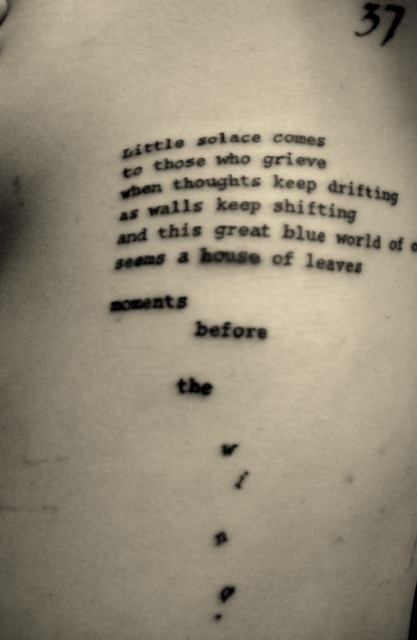
House of Leaves (both eventually lost it to Infinite Jest) a couple years ago. It was, after Catcher in the Rye, the first book that I would frequently draw from the bookshelf and start reading random passages out loud from. Sometimes I kept reading on for hours and way into the night before realizing that darkness had fallen around me. Its prologue is probably the piece of literature that I've read most often in my life. It still chills me to the bones. It starts:
"The snow in the mountains was melting and Bunny had been dead for several weeks before we came to understand the gravity of our situation."
And the situation is this: Richard and his new closely-knit circle of friends - eccentric and very reclusive classics majors at a prestigious New England Liberal Arts college; Richard always remains detached and an outsider to their minds, emotions, and actions - murder one of their own, Edmund "Bunny" Corcoran. Book I of The Secret History leads us from Richard's arrival at Hampden college and his integration into the group to their murder of Bunny. Book II is a painstaking examination of the psychological aftermath that the five of them have to deal with after the killing of their friend.
"I suppose at one time in my life I might have had any number of stories, but now there is no other. This is the only story I will ever be able to tell,"
closes the prologue and makes clear to everyone (who has skipped the book's motto's by Nietzsche and Plato) that this is also and foremost a story about storytelling itself. And for those who also skip prologues, Richard opens the first chapter:
"Does such a thing as 'the fatal flaw,' that showy dark crack running down the middle of a life, exist outside literature? I used to think it didn't. Now I think it does. And I think that mine is this: a morbid longing for the picturesque at all costs."
And it is precisely this morbid longing for the picturesque that suffuses Richard's narration throughout the novel.
A moi. L'histoire d'une de mes folies.
It was not until Tartt's second novel, The Little Friend, arrived on the scene and gathered some bad reviews - praising once more the brilliance of The Secret History - that I finally picked up her debut. And now, about nine years later, last week, I read The Little Friend. The reason I hadn't read it before was my conviction that it couldn't possibly surpass The Secret History in any way and why spoil my idolatry of Donna Tartt's writing, as some of the bitter reviewers did? But I see now clearly that she achieved pretty much what she set out for:
"After The Secret History I wanted to write a different kind of book on every single level [...] I wanted to take on a completely different set of technical problems. The Secret History was all from the point of view of Richard, a single camera, but the new book is symphonic, like War And Peace. That's widely thought to be the most difficult form."
I haven't read War and Peace, but I can see that The Little Friend is symphonic, and also a brilliant - and totally different from The Secret History - book. It starts out with a prologue in which we are told that nine year old Robin Cleve Dufresnes was murdered:
"He was hanging by the neck from a piece of rope, slung over a low branch of the black-tupelo that stood near the overgrown privet hedge between Charlotte's house and Mrs. Fountain's; and he was dead. The toes of his limp tennis shoes dangled six inches above the grass. The cat, Weenie, was sprawled barrel-legged on his stomach atop a branch, batting, with a deft, feinting paw, at Robin's copper-red hair, which ruffled and glinted in the breeze and which was the only thing about him that was the right color any more."
As we are told,
"the Cleves loved to recount among themselves even the minor events of their family history - repeating word for word, with stylized narrative and rhetorical interruptions, entire death-bed scenes, or marriage proposals that had occured a hundred years before - the events of this terrible Mother's Day were never discussed [though]. They were not discussed even in covert groups of two, brought together by a long car trip or by insomnia in a late-night kitchen; and this was unusual, because these family discussions were how the Cleves made sense of the world."
And thus it comes that 12 years later, when the story sets in and no murderer has been found, twelve year old Harriet, Robin's sister, sets out to make her own sense of the murder against a wall of silence from her family. And here you can see, again right from the first page, that this novel is also about storytelling. And the story that it tells is not so much about the death of Robin or who the murderer is, but about a whole town, Alexandria in Mississippi, in the late 1970's, and the people that live - and die - in it. And it is about that one long, hot, idle Southern summer that changes everything. And because it's a long, hot summer for a twelve year old, the narration is also, well, not long and hot, but exuberant, invasive and spreading out like the
kudzu - the vine that ate the South - that overgrows, and connects, so many places, and, metaphorically, people, in the novel. If you think plot, there are many loose ends. If you think characters, they are as three-dimensional as they get, even the two-dimensional ones.
Until her third novel arrives, I will pass the time listening to Tartt's great Southern voice, narrating The Secret History and The Little Friend herself, and, considering her
True Grit essay I think I will start with
her interpretation of Mattie Ross and Rooster Cogburn. I liked the book, the Coen movie not so much, but I'm pretty sure I will love Donna Tartt reading it out loud to me.