Showing posts with label DFW. Show all posts

Thursday, December 15, 2011

Breathing House of Leaves Tattoos

Everybody knows how much I love Six Feet Under and, after five incredible seasons, its finale and last sequence with Claire driving cross-country and time passing on relentlessly. And I love the song that plays over it and have listened to it so many times but I just came around to see the actual music video of it for the first time: Sia - Breathe Me

Why does it remind me of House of Leaves so much? Along with the video, I think, the song reverberates much much more with the book than Poe's Haunted or Angry Johnny.

Talking about House of Leaves, I came across this book cover art by Bas Alberts, which made 3rd place in the 50 Watts' polish book cover contest:

Since I liked it so much, I altered it and put it on a shirt. It's under a creative commons license and I only have to give the designer's name, which I did above and will tell everybody who asks me about the shirt.


Note: The blue leaves are actually navy-blue and the square next to the word House is exactly 5/16 of an inch big + the whole thing and therefore the words are mirrored. Then I made something up for the back, too.


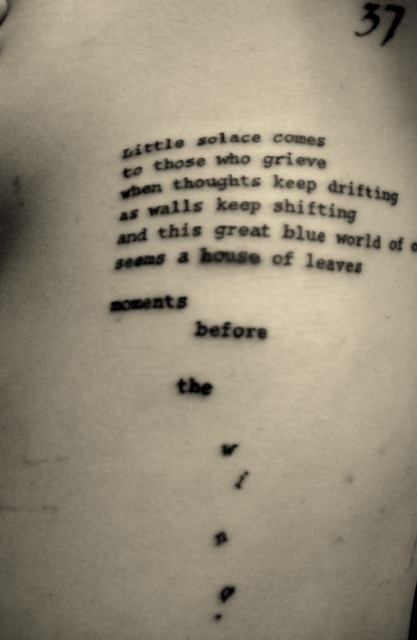
I still need some suggestions for a House of Leaves inspired tattoo. Shouldn't be as big as these:


Or maybe something Bret Easton Ellis?


or David Foster Wallace?

Why couldn't I find a pic of a thumper tattoo barely an inch from a shaved pussy? This is the internet! Has nobody got such a tattoo? I can hardly believe that.

Saturday, December 03, 2011

david foster wallace was depressed by karen green

This is just incredible. You know what I do most on this blog? Besides blogging, which I don't do too often anymore, I am checking the stats to see how many and which and where and what led them here, people (is this a legit sentence anymore?) find their way to my site.

In the very first weeks, there was always some guy from Denmark on my site, actually checking daily what I wrote and what not. He ceased (maybe he deceased) doing that. The post that was read most often on my site, is this one about DFW, Karen Green and MZD and guess how people come to surf on it.
Someone actually googled: david foster wallace was depressed by karen green. And take a look at the links google gives for this search. There's not only "David was a big sweater" but also, and, well, you can check it out, a guy that tries to convince you that "Roger Federer killed David Foster Wallace."
He's somehow paralleling Federer's not so good performance of 2008 to DFWs equally not so good performance of 2008, which led to his suicide on September 14th, and well, somehow, Federer is a lousy saviour after all, and won the US Open on September 13th 2008. The argument goes something like this: In his piece about Federer, Wallace idealized Federer as the saviour, yes, Jesus Christ or GOD himself (does the idea of GOD contain a self, anyway?). Although Federer sucked bad, the whole year, he finally nailed the US Open and let's see, what our little friend on the other side of the internet has to say about it:
Federer would win the US Open on September 13th, but it was likely too late for redemption. God's immanence on Earth had been retracted, the age of miracles was over. DFW was found hung the next day.
 I would like to add the opinion that Federer's win was actually thought of  by DFW as the second coming of christ and so he subsequently hanged himself the next day to see if he was already dead. Jesus!

Saturday, October 01, 2011

September 2011 Wind-up

Since I wrote about 90% of all posts from my former workplace (former, yes, indeed. But don't worry, they didn't fire me for blogging related reasons) there hasn't been much posting in the last couple months on my behalf. So I decided, like, today, that I at least give you little list-like impressions of what is, or rather was, going on in my literary, filmic, musical or otherwise musings once a month. This is less inspired than just kicked-off by Nick Hornby's monthly column "Stuff I've Been Reading" for The Believer, which I've been reading this month. Actually I just read it a couple minutes ago. Since I hadn't known at the beginning of the month that I would start such an endeavor at it's very end, I have to guess some of the stuff that made apparances this September of 2011 but failed to inscribe itself deeply into my memory. And since, quoting Bill Pullman in "Lost Highway", 'I like to remember things in my own way, not necessarily in the way they happened', don't blame me if any of the following, or preceding, for that matter, information is incorrect or fails to register with whatever fascist-mode of truth your brain is operating on. So, here it goes:

Stuff that I bought:
  • Quentin Tarantino, Inglourious Basterds, BluRay
  • Marcel Proust, Auf der Suche nach der verlorenen Zeit, 13 Bd.
  • Sigmund Freud, Vorlesungen zur Einführung in die Psychoanalyse & Psychologie des Unbewußten
  • Ernest Hemingway, Tod am Nachmittag
  • Vladimir Nabokov, Lolita
  • J.D. Salinger, The Catcher in the Rye
  • The Believer, September 2011 issue
  • The Believer Book of Writers Talking To Writers (Revised & Expanded)
  • A ticket for the upcoming BUSH concert in Cologne on Nov, 8th 2011

Stuff that I read and watched and listened to:
  • Bush, The Sea of Memories
  • Daily Bread; Well, You're not invited
  • The Decemberists, Calamity Song
  • Quentin Tarantino, Inglourious Basterds
  • Lars Von Trier, The Element of Crime
  • Lars Von Trier, Epidemic
  • Lars Von Trier, Europa
  • Lars Von Trier, Breaking The Waves
  • Lars Von Trier, The Idiots
  • Lars Von Trier, Dogville
  • Lars Von Trier, Manderlay
  • Jorgen Leth, The Perfect Human
  • Lars Von Trier, The Five Obstructions
  • Lars Von Trier, The Boss of it All
  • Thomas Vinterberg, Dear Wendy
  • Seth Gordon, Horrible Bosses
  • John Michael McDonagh, The Guard
  • Californication, Season 4
  • some U.S. Open
  • Bernhard Schlink, Der Vorleser
  • Jonathan Safran Foer, Extremely Loud And Incredibly Close
  • The Believer, September 2011 issue (unfinished yet, it's a bathroom read)
  • The Believer Book of Writers Talking To Writers (same as above)
  • David Foster Wallace, E Unibus Pluram: Television and U.S. Fiction (in ASFTINDA)
  • Thomas Pynchon, Gravity's Rainbow (not finished yet)

Well, what can I say? I was preparing for Lars Von Trier's Melancholia by watching all, almost, the stuff that I hadn't watched before and by rewatching all the stuff that I had watched before. And although Dancer In The Dark and Antichrist and Riget are not on that list, I pretty much got it all covered. I have to say that I was really surprised of the variety of his work. Especially his early Europa-trilogy is quite distinct from his later works in visual as well as in narrative style. All of them, The Element Of Crime, Epidemic, Europa, and Dogville at the very forefront, distinguish him as a master storyteller. And apart from the gut-wrenching border-crossings of the human soul starting with Breaking The Waves, he can just as easily pull off an extremely funny comedy like The Boss Of It All. Alright, yes. The last 15 or so years have been a constant tumbling down the rabbit hole of depression and we will have to see if Melancholia will be the end of that or just another apex in his CV. But even in this condition he is an extremely gifted filmmaker. I'm looking forward to everything he gets on the big screen.

Proust: I do not know when or if I will ever have the time to read him but this complete German edition of his À la recherche du temps perdu smiled at me from an 'each book 1€' flea market box. I got the whole bunch for 9€! Also, since I once owned the complete Freud Studienausgabe and sold it on eBay several years ago and now it costs like 100€ up and I'm trying to get my hands back at those books, I got volumes I and III for a euro each at the flea-market. The Hemingway I bought for my brother since he loved The Old Man And The Sea and The Sun Also Rises so much, but doesn't read English so well, hence the German edition. Death In The Afternoon was the only Hemingway I could find there and since there was the very last bullfight in Barcelona this week I thought it would be a nice gift. I mailed the book to him and he didn't respond whatsoever to this niceness of mine. Hm...


Today I bought the Salinger and Lolita. And this is probably the very first time in my life that I bought something for myself of which I have a perfectly good copy at home already. The Catcher In The Rye, that is. Actually there had already been two copies on the bookshelf, the other one belongs to my girlfriend. But I just couldn't resist the wonderful book jacket. It looks so graceful and dignified. I had to buy it. And then I had to think of that Mel Gibson flick, Conspiracy Theory, in which he owns a couple dozen copies of this very novel but can't give a reason why. Or at least I didn't get to know the reason, I never watched the movie, but know just that one scene. Weird, isn't it?


And I stumbled upon The Believer magazine, which is a part of McSweeney's, which, respectively, is owned and published by Dave Eggers, sort of, because of an interview with Don DeLillo and Bret Easton Ellis, so naturally I had to get ahold of a copy. There is also an interview with Jason Schwartzman in it. But this darn Ellis DeLillo interview is ONE YEAR OLD!!! It took place in Paris in October 2010 when both of them promoted their latest novels, Imperial Bedrooms and Point Omega, respectively. And since I'm an avid reader of DeLillo and Ellis interviews, there was about nothing new in it, because they told all that stuff to dozens of other interviewers already. That sucked. The Believer Book of Writer's Talking To Writers arrived a couple days later and at least I do not know so much of the contents of those interviews beforehand, because, frankly, I know just about half a dozen of the (three and a half dozen) writers featured in it. And that is a good thing. I like interviews with writers and those are quite interesting. They nevertheless never reach the quality or length of those featured in The Paris Review.


And the really big thing after Lars Von Trier: I, as you already know, started reading Gravity's Rainbow. I'm about 130 pages deep now and don't really have any words that I would want to W.A.S.T.E. upon this. Therefore I will end this post with the video for The Decemberists's Calamity Song. And I have to make that clear: It is the video, not the song that I like and appreciate for obvious reasons.

Monday, September 12, 2011

extremely bitchy and incredibly clever

As I write this - between the points - I am witnessing the most compelling tennis match that I ever witnessed in my entire life. It is the US Open 2011 women's single finals. Serena Williams vs. Samantha Stosur. The first set was a powerful demonstration of Stosur's aggressive and concentrated domination of the game and, respectively, Williams. Stosur obliterated the shit out of her oponent and won the first set 2-6 after just 31 minutes. Williams had no foot on the ground even when serving for the second set when she had a curious idea. It is break point for Stosur. She returns Williams's serve to the far left corner and Williams does the same when she - ball about exactly over the net - gives a little high-pitched shout. It is loud enough - as women's in-game (exactly now, after 1:13h the match and therefore the women's championship is over) shouts go - for everybody to hear, and also for Stosur to be distracted and mishit the ball. What was peculiar about Serena's shout, though, was that it was designed to break Stosur's concentration. Shouts normally come either when hitting the ball, this has to do with breathing technique and releasing power mostly, or to bring yourself back on track, to aquire or regain a level of concentration that is needed to turn the game around. And that it did. But more so because it was neither when she hit the ball nor after she lost or won the point but right before Stosur was about to hit that little yellow fucker.

The umpire then called point Stosur which meant she got her break - although she didn't get the ball across the the net anymore - because Serena's cry was against the rules, which I think was the perfectly right decision. But Serena was unhappy with that decision and struck up a little dispute with the umpire and then the audience chimed in, whistling loudly and aggressively. For about two minutes. When Stosur finally decided to go on and serve despite all the whistling and shouting, they quieted themselves just to roar up again, when Williams got the point. The trick was done. With Stosur's concentration completely broken and a roaring audience behind her, Serena immediately got the re-break and, following her serve the next game, lead for the first time after the very first game in this match. They played the most amazing points in this stage of the game.
The end of the story is that Stosur came back, big time, and eventually won the match and thus the tournament and thus her very first grand slam title, after 1:13h with 2-6, 3-6. That was the best tennis match I ever saw.

Thursday, July 14, 2011

World of Leaves

Enjoying literature is not an easy thing to do. At least not if you try to lead a normal life, that is, whatever that is. Because there is so much of it around. Nothing but letters in endless combinations. Sometimes I wonder if I would go mad or start a philosophical or armed war in Borges's Library of Babel, engage in bare-knuckle-fights, bludgeon the skulls and smash the brains of fellow searchers with uncreased spines of books that have never been opened. Would I take a pencil with me and scribble in the margins, multiplying the already infinite number of possible texts further or would I stab my own eyes and pierce my tongue and throat with it to free myself from the curse of written and spoken language? I would have to pierce my eardrum as well as my own brains, too, writing my last unreadable message with lines of dripping blood.

Having just finished Cosmopolis, I am confronted with choices that I can hardly grasp. Every step from now can lead me in the wrong direction. What should I read next? Should I go back to DeLillo's beginnings and read him in chronological order or rather go directly to Underworld? What about Pynchon? Gravity's Rainbow or start with V.? What about the still not finished Barthelme and Barth? Robert Coover's Universal Baseball Association, because DFW mentioned it in some interview? And DFW himself. Besides Infinite Jest and The Pale King and some of his journalism, I haven't read anything else. What about rereading Infinite Jest? And Don Quixote, the new 70,- € German translation is still waiting for me, as well as Bolano's 2666 and Márquez's One Hundred Years of Solitude. Paul Auster after The New York Trilogy, another round of House of Leaves, Catcher in The Rye or turn to Franny & Zooey and Salinger's other writings? Donna Tartt's The Little Friend is waiting on my bookshelf for the last 6 years or so. Maybe 8. I was a totally different being back then (well, not so radically different as I wished I would be.) The Amazing Adventures of Kavalier and Clay or some more Vonnegut or Safran Foer's Tree of Codes, Cormac McCarthy's Blood Meridian, what about Proust and Nabokov and every single Sherlock Holmes story? William Gibson, James Ellroy, William Gaddis, Zadie Smith and Flannery O'Connor. Toni Morrison. I could go on for days, literally, and weeks, losing much of the precious time I would otherwise spend reading some of that (or other) novels. One thing at least seems to be pretty clear to me: After finishing Franzen's self-indulging The Discomfort Zone, he will be off my reading list for a long, long time.

The Tree of Life, The Pale King and Enter The Void

Some of you (who, actually?) might wonder what I think about Terrence Malick's The Tree of Life and DFW's The Pale King, because I fell pretty silent after having watched and read those works.

Well, the reason is that both of em pretty much leave me speechless. There is not much to say about The Tree of Life other than: Go watch it. Wherever and whenever you get the chance to see that movie on a big screen, do it! This is a cinematic experience that you will rarely encounter in your life. If you plan to see it but don't feel the urge to do so in a movie theater: Don't. By which I mean, rather never see it in your whole life than not on the big screen. You would not want that. You will want to avoid your emotions of regret and loss for having avoided it in the theater. A couple of weeks ago I strained an ankle because I tried to get the best possible seats for a one-time screening of Kubrick's 2001 in a local theater. The pain kept me from being able to watch the darn thing. But nevertheless, 2001 on the big screen is exactly the thing you want to be willing to strain an ankle for. So is The Tree of Life. (As well as Gaspar Noé's radically visionary Enter The Void, of which you can see the trailer here, the opening credits here and the first 10 minutes here, just to make you want to watch it on the BIG SCREEN. This is a physical experience that "essentially flips the brain-off switch for you"). I've seen The Tree of Life two times already and will do so a third time next week. Anyone with an interest in cinema will want to see this visual masterpiece. Again, on the big screen. It does not work in any other way. It makes no sense at all to watch it any other way.

Regarding The Pale King: I do not dare put my words to anything, really, that DFW put on page but, again, read it (this time not on screen though, not even a big one, whether it is standard Kindle, IPad or 24" wide-screen sized, but on page in a published book). His writing and ideas are far from boring. It is true, yes, that The Pale King is unfinished, and you will notice it when you arrive at the last pages, especially at the appended notes and asides found with Wallace's manuscript. From the feel of it, with its about 560 published pages, about the same amount is missing. But what is actually there between the covers, is still among the best literary achievements you will be able to find by any living (or dead) American writer.

Wednesday, June 29, 2011

report all obscene mail to your potsmaster

I don't particularly like Jonathan Franzen, as a writer and as a public persona, that is. Freedom was hyped over the top and yes, maybe it is the best social realist novel since The Corrections (which I have yet to read) and by any living American writer in a long time but I really couldn't care much about any of those characters. They were, by and large, pretty boring. And if you ever saw or read an interview with Franzen you might come to the conclusion that the only interesting thing about him was his close friendship to DFW. And this is the only reason why I'm reading his collection of essays and arguments "How To Be Alone" and some random interviews (his Paris Review 'The Art of Fiction' interview from the Winter 2010 issue is now fully available online) and articles like the New Yorker piece about him scattering some of DFWs ashes on an isolate island, Robinson Crusoe and a rare bird (pdf here). A wildly incoherent article, by the way.

But nevertheless, Franzen does have and is able to create a very nice and soothing narratorial voice, making Freedom mostly, despite the characters, a pretty pleasurable read. And also "My Father's Brain", the opening essay from "How To Be Alone" is a very immersive and nicely plotted piece of autobiographical writing that makes want for more. And so, a few essays into the book, I came upon "Lost in the Mail". And this one is also nicely plotted and told, about a 1994 breakdown of the U.S. Postal Service in Chicago where citizens didn't receive mail for weeks and postal workers either hid thousands of letters in their apartments or burnt them - over the course of several years - to obscure the fact that they didn't finish their routes. Some of them drank on duty and stopped in bars to watch sports tv for hours on end to collect overtime payment afterward, etc., etc. One citizen even reports "Mailman harasses us at night, asks for money." As Franzen tells it, this is USPS apocalypse, which makes for a good story (this seems to be his first ever piece for the New Yorker).

But then, at the very end of this essay, when Franzen sums up his nostalgic feelings and thoughts for the US Postal Service in general and the 1994 outrage in particular, he presents the reader with a sudden erratic, out-of-line and out-of-context statement:
"The burning of mail in a viaduct deals the same blow to our innocence as the pederasty of priests."
WTF?! Really? Yes. I checked it several times. There's no mention of priests or pederasty or the confluence of both anywhere before in the text. And to compare the burning of mail to priest's pederasty is the one really big twist in his going-postal narrative. What was he thinking (and re-thinking while proof-reading) or the editors at The New Yorker? Has this been commented on? I mean this essay is 17 years old and the very first thing that google returns when I type in "franzen priest pederasty" is a facebook group that is called "Father Franzen was the best priest ever. end of story." What's going on?

Two essays further into the book, "Sifting the Ashes": Franzen tells a neat story about the rise of the tobacco industry in the U.S. and about coming to terms with his own habit of smoking. Let's see if he deals another blow to our innocence as with the mail-burning child-fucking thing:
"My mother still speaks of cigarettes with loathing. I secretly started smoking them myself in college, perhaps in part because she hated them, and as the years went by I developed a fear of exposure very similar, I'm convinced, to a gay man's fear of coming out to his parents."
Little Jon, who will tell everybody (those who ask about it + those who don't) about his happy and unspoiled High-School time, becomes a little rebellious and smokes a cigarette or two and believes, honestly, he feels the same (well, very similar) dread of exposure of a gay man of coming out to his parents. This is from 1996. Jon Franzen, who grew up in Webster Groves, a St. Louis suburb of 23,000 people. So much about where his sense for social realism comes from. Considering how he built up smoking as a very bad thing indeed before, he seems to say that homosexuality is a) a bad habit, b) something addictive, c) something that makes you sick d) and over the long haul kills you, e) in its function similar to the ending of the world, a personal apocalypse.

I'm really looking forward to read the other pieces in this book.

Tuesday, June 14, 2011

emotion and irony in contemporary fiction

"What I'm mostly trying to talk about is what it feels like emotionally to be 34 in this country."
This is from a DFW interview from Spring 1997 that can be found here and it pretty much sums up what is going on and what has to be done in serious contemporary fiction, i.e. the turning-away from postmodern irony and the turning toward emotional truth. You can see it in DFWs work, most recently in The unfinished Pale King, you can see it in Alan Ball's Six Feet Under, it is what Bret Easton Ellis did in Lunar Park, what Dave Eggers's A Heartbreaking Work of Staggering Genius was all about, as well as Foer's Everything Is Illuminated and also recent TV-shows as Bored to Death - although sometimes they hide it very well -, it is what Terrence Malick does and what Jonathan Franzen's Freedom tries to do. Also Running With Scissors comes to mind, and quite strongly though, i.e. the movie version, I haven't read the memoir. And this is what an LA Times critic had to say about it :
"Murphy, who created the creepy, funny, lunatic "Nip/Tuck," is a master of mordant and macabre camp. But here he loses his teeth, seeming to lack any ironic distance from material that practically begs for it."
The critic herself doesn't seem to lack the ironic distance that she is actually begging for, though. I don't know where to find it right now, but Jonathan Franzen said it in one of the myriad of interviews he gave in the wake of Freedom. He said that in The Corrections he used irony also and especially to distance himself from certain ideas and emotions presented in the novel. You can basically say anything you want with irony and then easily back out of it if people disagree with you, thus you don't have to stand your ground on very intimate issues, issues that are and feel way too personal to let anyone attack or make fun of them. He said that he wrote a wholeheartedly unironic novel with Freedom, that he eschewed former techniques of irony to get closer to the emotional core of what he wanted to say. And that he is quite aware that exactly that makes him so much more vulnerable if people dislike his work because now the work is much closer to what being Jonathan Franzen really is like. Closer to the emotional truth that is Jonathan Franzen. But people might misread that for sentimentality and naiveté.

Here is something I found in an IRC chat transcript with DFW* shortly after the release of Infinite Jest (and if you are too young to actually have been in one yourself or are now like, my age, and want to get a nice pretty nostalgic trip into the early times of the internet and 90's chat-rooms, you have to read the whole thing (if it doesn't redirect you, click on the Impatient? link). This is pre-facebook stuff. There were actually online chat-rooms BEFORE the internet. Grab yourself a cup of coffee or your beverage-of-cozy-choice and travel into 1996's cyberspace):
"The worst thing about irony for me is that it attenuates emotion" and
"I don't think irony's meant to synergize with anything as heartfelt as sadness. I think the main function of contemporary irony is to protect the speaker from being interpreted as naive or sentimental."
Irony can be a lot of fun, no doubt. And as Dave puts it, we can't escape it because we breathe the stuff everyday. And that makes it actually hard to snap out of it sometimes. (Is the transition to this paragraph too rough? I had a hard time coming up with a coherent one after the quotes.) And I think that is exactly what happened to the LA Times critic a couple lines above. She sees the lack of ironic distance and wants her ironical borders restored immediately to not have to look too closely at something that intends to produce exactly this: a close emotional relationship with its audience. It is precisely not about irony, not about safe distance, not about making fun of everything. It is about emotion. And in the case of this critic, and a lot of others, I fear, about the misreading as being naive and sentimental.

*almost all DFW-related sources are found and taken from The Howling Fantods.

Saturday, June 04, 2011

DFW, Federer and Nadal, This Sunday

The French Open. Today. Men's Semifinals. Rafael Nadal vs. Andy Murray and Roger Federer vs. Novak Djokovic. The top 4 in the world. Djokovic has won about every single tournament this year he showed up for and would have climbed the world ranking to #1 if he had beaten Federer today. The match was hard, but he didn't (win, that is). He lost the tie-break in the fourth. Earlier Rafael Nadal had a very hard match against Murray, who had about a hundred break points that Nadal all defended, at least in the end stage of the third set. The second set was "großes Tennis", as we say in Germany. It was Nadal's birthday, too. His 25th. Congratulations!

Why am I telling you about this, you might ask. Tennis is of no interest to me. I thought this blog was about literature (and movies and stuff, too!) Well, it might interest you, because the French Open Final on Sunday at about 2:45pm Middle European (Summer) Time is Rafael Nadal vs. Roger Federer and David Foster Wallace wrote a little piece for the New York Times's (regard Strunk and White!) Play Magazine on Federer back in 2006, mostly about the Wimbledon Final between Nadal and Federer, that is called Federer as Religious Experience, and that might interest you, if you are into tennis or not (DFW would suffice for that matter).

The semifinal between Nadal and Murray was mostly what is known as a "hard-hitter" match. Both most of the time residing at the base line, hitting hard across (or long-line) the court. It is something that DFW describes as "brute force" in his NYT piece. And there is not so much grace in it, I agree. The other semifinal today, between Federer and Djokovic was somehow lighter, much more playful, with a lot more variance in the game. Murray outplayed Nadal with stops a lot, something Nadal apparently couldn't cope with or understand, for that matter. It was 52 minutes into the match that Nadal played his first stop. There were two or three more in the match from him, and they hit Murray as much by surprise as Murray's had disconcerted Nadal. It was a match about every single point. Only two games went straight through. The first by Murray, the second, and final, thus winning the match, by Nadal.

Last year was the first that I watched some tv-tennis due to the interest in the sport that DFW induced through Infinite Jest. The only match I remember now (and only in terms of that I watched it and what general impression it left on me) was a match between Söderling and someone else that left me with the impression that hard-hitting tennis is no game of grace, of which trait (is grace a trait?) I thought modern tennis is robbed, or deprived of (I hadn't seen a tennis match in about 2 decades before that, so that evaluation might have been quite arbitrary). But the Wallace piece mentioned (and linked to) earlier describes exactly that. The change from virtuosic (and also dumb serve and volley) tennis to improved-racket-hard-hitting-top-spin-tennis (devoid of grace, until Federer). So, the Nadal vs. Murray match was mostly hard-hitting, but I attribute this more to Murray's style of play. Federer vs. Djokovic was a bit more virtuosic, it was softer, there was more touch, more feel to every ball, to every point and although The White Stripes sing "the problems hide in your curls" Federer really nailed Djokovic down every time he tried to run off with his incredibly deserved break-points. Also Federer doesn't have any real curls. The fourth and fifth were very fine tennis, indeed.

So, actually this is it. I'm looking forward to the women's finals tomorrow (Li Na vs. Schiavone) and the Nadal-Federer match on Sunday. If anyone wants to join me, you know where I live. If not, I probably don't know you but would nevertheless be pleased to watch the match with you. In the meantime, read the DFW piece and prepare yourself for a classic tennis match. It's like Germany vs. England in football (btw, I feel terribly sorry that Gomez scored twice today against Austria despite of being in the worse team. He should get a new haircut, too!).

By the way: I really tried to find that point between Federer and Agassi that DFW first talks about, but couldn't. I actually think it a) does not exist or b) was not televised. You should watch the fourth set of that match nevertheless, since Federer OBLITERATES Agassi 6-1. Federer is at the top of his game and Agassi just a few days before officially announcing that he quits active tennis. So long.

Almost forgot, a quarter-funny (quarter-final?) version of the "Hitler upset with" series.

Wednesday, June 01, 2011

Boredom, DFW and Temporal Dynamics

"Maybe dullness is associated with psychic pain, because something that's dull or opaque fails to provide enough stimulation to distract people from some other, deeper type of pain that is always there, if only in an ambient low-level way, and which most of us spend nearly all our time and energy trying to distract ourselves from." - David Foster Wallace "The Pale King"
"Sein [des Menschen] Leben schwingt also, gleich einem Pendel, hin und her zwischen dem Schmerz und der Langeweile, welche in der Tat dessen letzte Bestandteile sind." - Arthur Schopenhauer
I have distracted myself. I think. Or have I?

I came along a post about boredom and The Pale King earlier and a little essay (link is in the comments) about how to go through full boredom to make it more interesting and a rewarding experience. Having been bored at the time and also tired I didn't pay much attention to it. Yes, my boredom hadn't ceased for the time being. Also I think it did not make much sense. But that may solely be linked to the fact that sense-making and clarity are qualities that don't go well with boredom. The point made in the post (if I'm not mistaken) is that voluntarily entering a state of boredom makes the whole thing much more interesting and even rewarding because what follows is a better level of attention. And, well, yes, better attention is on the way, all right, because some form of attention always follows boredom, since lack of attention is one of the things at the dead center of boredom. Hence (symplified): boredom = no attention --> attention = more attention than no attention. But the other thing is quite impossible, to enter a state of boredom voluntarily. There's a twist in it that does not work.

I feel a strong connection to the impossibility of a perpetuum mobile and an inventor I once corresponded with regarding his plans to build one exploiting oceanic maelstroms. There was a point in his theory where he was mixing warm and cold water-masses and thought they would add up and thus provide the extra amount of energy that not only kept his machine running on its own but could also turn the lights on somewhere. But of course the temperatures of a cold and a hot mass of anything do not add up, they even out. Creating a lukewarm mass of something and that is what we call entropy (simplified). And entropy is certain. The only way to heat a lukewarm mass up is to heat it up. From the outside, that is. The water can't heat itself up just by entering a mental state of voluntariness. There is no voluntariness and thus no free will in the water. And we could have lenghty arguments over if there is free will in human beings or any living (or dead, what's that all about anyway?) matter, for that matter.

Now consider boredom a lukewarm mass of indifference, an entropic state of the mind. There is no way to voluntarily enter such a state other than yearlong sensory deprivation. And that is also not possible because our body needs input from the outside (and gives output from the inside) and this serves as massive stimulation if the other senses are shut down for awhile. And even the momentarily giving in to boring activities with the purpose to come up with another level of attention requires a not insignificant amount of attention and thought-provocation that renders the former boring and tedious task indeed very interesting. So what was proposed in the post is not going through boredom to gain better levels of attention but to come up with ways and techniques to instantly turn boredom into something useful, thus interesting, beforehand. It is a prepared stimulus that is supposed to kick in every time your mental state goes boredom. It is a machinery set up to provide you with impulses (from the outside) to prevent boredom. And doing so is a very paranoid form of dealing with boredom and brings us back to the underlying pain in human beings and the quote from The Pale King: "which most of us spend nearly all our time and energy trying to distract ourselves from."

Let's imagine time as applying to the laws of thermodynamics, since a feeling of slowly passing time is also associated with the concept of boredom.
  • First Law of Temporal Dynamics: there is a fixed amount of time. There is no way to produce more time than there is. No new time is added. No past time is lost. The present is the focusing of one's attention on a particular spot of time.
  • Second Law of Temporal Dynamics: Time strives toward entropy.
  • Third Law of Temporal Dynamics: Time with absolutely no content to focus on is it's dead center. This point of absolute zero can not be reached.
From these Laws of Temporal Dynamics we can further deduce (I never paid much attention in that Poe/Peirce seminar considering the differences between deduction/induction/abduction) some concepts:
  • We can work with time. We can accelerate it or slow it down by putting it to use, filling it with various content and actions, structuring it.
  • The quality of time's absolute zero is full entropy, an equilibrium of time. It is time that is completely unstructured by the mind.
  • Boredom is the approximation of one's mind to time's dead center, approaching a mental state without impulses, without stimulation, without structure, without content.
  • The underlying psychic pain that is associated with boredom is the experiencing of time's true nature, which is eternity.
So far for now. Any comments?

Thursday, May 26, 2011

DFW - DeLillo Correspondence

As some of you might know, I'm trying to get hands on the letters of correspondence between David Foster Wallace and Don DeLillo. I know where they are. But I need some help to lay my eyes and soul on them. In the wake of the opening of the DFW Archive at the Harry Ransom Center at the UT, Austin, pictures of some of the DFW material circulate the net, the internet, that is, but unfortunately the number of links to websites that present them is far greater than the actual # of photographies of that stuff, meaning, they show all pretty much the same stuff. Ransom Center has also a nice digitalized thingy up that shows various steps of what became §9 of The Pale King from first draft to final black-ink-on-white-page-in-buyable-book-draft. A LOT of it is already linklisted over on The Howling Fantods's news by category list titled DFW Archive. This is also by far the most comprehensive website considering DFW. Has also a nice list of conference and master theses papers on DFW up there and so on.

But it is pretty hard to find actual copies of the letters of correspondence between DeLillo and Foster Wallace. This might be because of legal-copyright-stuff-reasons. For what I know the Ransom Center offers to make copies (putting their watermark on them) for money and just demand that whoever wants to publish some of the material make a kind of legal or heritage disclaimer that very clearly states where that material comes from, i.e. the Harry Ransom Center in Austin, Texas. So that shouldn't be the problem, if I'm right about this, which I'm of course not quite sure of. And the whole thing is much more non-comprehensive for me, because the letters of correspondence between David Foster Wallace and Don DeLillo are not even part of the newly opened DFW archive, but they are part of the DeLillo archive, which was acquired in 2004. So lots of people had lots of time to get their hands on them even before DFWs death in 2008 and, consequently, the acquisition of the Foster Wallace material a year later.
However, the letters range from the very first letter in 1992 to 2003. And that's not because they stopped writing each other, but of course because the DeLillo archive, acquired in - see above - 2004, stops in 2003. And just if you're wondering about this: Yes, Don DeLillo is still among the living.

Really the only digitalized letters I could find are those linked below, including the above mentioned very first letter DFW ever wrote to DeLillo.

So: if you are in possession of (il)legal digital (or hard) copies of any of those letters of correspondence between David Foster Wallace and Don DeLillo or if you live in Austin, Texas or elsewhere but would be willing to visit the Ransom Center or if you are an employee of or employer at the aforementioned Harry Ransom Center at the University of Texas in Austin, Texas and are willing to make copies of those letters whether legally or illegally and are willing to send them to me via electronic means or quaint ones or if you happen to know anyone in possession of some of those letters and you are able to persuade him/her that it is necessary to make them available to me or otherwise just rob him/her w/r/t the letters/copies so please do by all means all that is necessary to achieve that goal because your moral and spiritual integrity is on the line, even if you feel that you do not know me and have no possible obligation w/r/t the person that constitutes myself, the fact that you chose not to do something about this situation will nag at your consciousness day in day out until finally, eventually, your self-centered self will turn into a self-devouring self and there will be tics and symptoms, physically and mentally, to go with the self-devouring that will make you wish you had done something about my longing, my desire and despair, earlier, in order to keep your normal happy life from turning itself into a permanent state of desperate desirical self-hatred and mourning for lost opportunities like this one to make your personal life and life in general a better place to dwell while time passes relentlessly until the very end and makes you want to wish you had - as mentioned above - given me and the world what I wanted, namely some possibility to lay my eyes and soul onto some of the letters of correspondence between the late David Foster Wallace and the still-among-the-living (as far as my knowledge goes) Don DeLillo and if you do claim you know not where they are, they are right there at the Harry Ransom Center of the UT in Austin, Texas, right there in the DeLillo archive, Series II. Correspondence, Subseries A. Alphabetical Files, Individual correspondents, Wallace, David Foster, with replies from DeLillo,1992-2003, n.d., Container 101.10 or box 101, folder 10.

The letters I tracked down so far
  • In a pdf from kottke.org including the very first from Wallace, dated 11 June 1992 and one by DeLillo dated Feb 5, 1997: here
  • Ellis from It's A Livre Life visited the Ransom Center in February 2011 and put these fragments up (on what would have been Wallace's 49th birthday, actually) and a little later a full letter by DFW dated 10-10-95

Thursday, April 28, 2011

DFW, Karen Green and MZD

I just found this in a Newsweek article considering the David Foster Wallace archive at the Ransom Center in Austin, Texas:
After his suicide, Nadell drove out to join Wallace’s widow, Karen Green, who was eager to move out of a haunted house.
What struck me immediately upon reading Infinite Jest (upon a myriad of other things) - I had read House of Leaves before that - was the connection between Wallace's superdrug DMZ and Danielewski's initials MZD. Infinite Jest is, through its footnotes, framed inside a network of drugs. House of Leaves - through Johnny's introduction - also dives right into it. The other thing is the Karen Green connection.

Does anyone know more about if Wallace and Danielewski knew each other or what each other's work meant to them? Did Karen and Dave already know each other before House of Leaves was published? This Guardian article about Karen gives at least the hint that they first met after he published "The Depressed Person" in Harper's Magazine in 1998, which would later become part of his short story collection "Brief Interviews With Hideous Men". With House of Leaves being first published in 2000 this gives definitely time for character name corrections on MZD's account.
In that article is something else, very remarkable I think, in it:
Green became an amateur expert on the diagrammatic language of psychiatric records: "That's a depressed person's brain," she says of a little grouping of Technicolor splashes. "It's coded differently."
And it reminds me of how DFW always used to speak and write about the hardwiredness of clinical depression and addiction. Karen Green also says this, which I will leave without a comment (although, isn't the bare fact that I say I will give no comment, a very strong comment in itself? Whatever, the autopsy report is right here):
"What do you do when your husband's autopsy report is on the internet and is deemed a subject worthy of fucking literary criticism?"
Regarding publishing of the unfinished The Pale King, she remarks:
"The notes that he took for the book and chapters that were complete, were left in a neat pile on his desk in the garage where he worked. And his lamps were on it, illuminating it. So I have no doubt in my mind this is what he wanted. It was in as organised a state as David ever left anything."
and also:
One of Green's many fears for the publication of The Pale King is that it will be read as an extended suicide note, as an explanation for the ending that Wallace gave himself.